Many learners search spellings at glance adding full but powerful is correct while powerfull is incorrect under grammar rules. This often creates spelling mistakes that reduce writing credibility, even when people feel both forms look reasonable at first glance. The confusion comes from English spelling rules, where correct form always depends on structure, not guesses, and the version powerfull with a double l never follows proper rules. This is why Many people search and try to confirm in a dictionary, because only one correct English word exists.
From a language point, forming adjectives and adverbs is an easy task, where a noun can change using a suffix, such as adding suffix -ful to noun power. For instance, friend becomes friendly, and correct becomes correctly, showing how each word must follow rules in writing and professional communication. People often type powerfull, but the correct spelling always comes from proper forms adjective usage, not from adding full word full, because the correct English word uses only one “l” in -ful, not “full.”
- The correct spelling and why it matters
- The meaning of “powerful” in real-life contexts
- The origin of the word and how English formed it
- Why people still write “powerfull”
- Pronunciation, synonyms, antonyms, and usage rules
- Real examples and writing insights you can actually use
No fluff. Just clear language and useful explanations you can apply immediately.
Powerful vs Powerfull: The Correct Spelling Explained Clearly
Let’s settle the debate first.
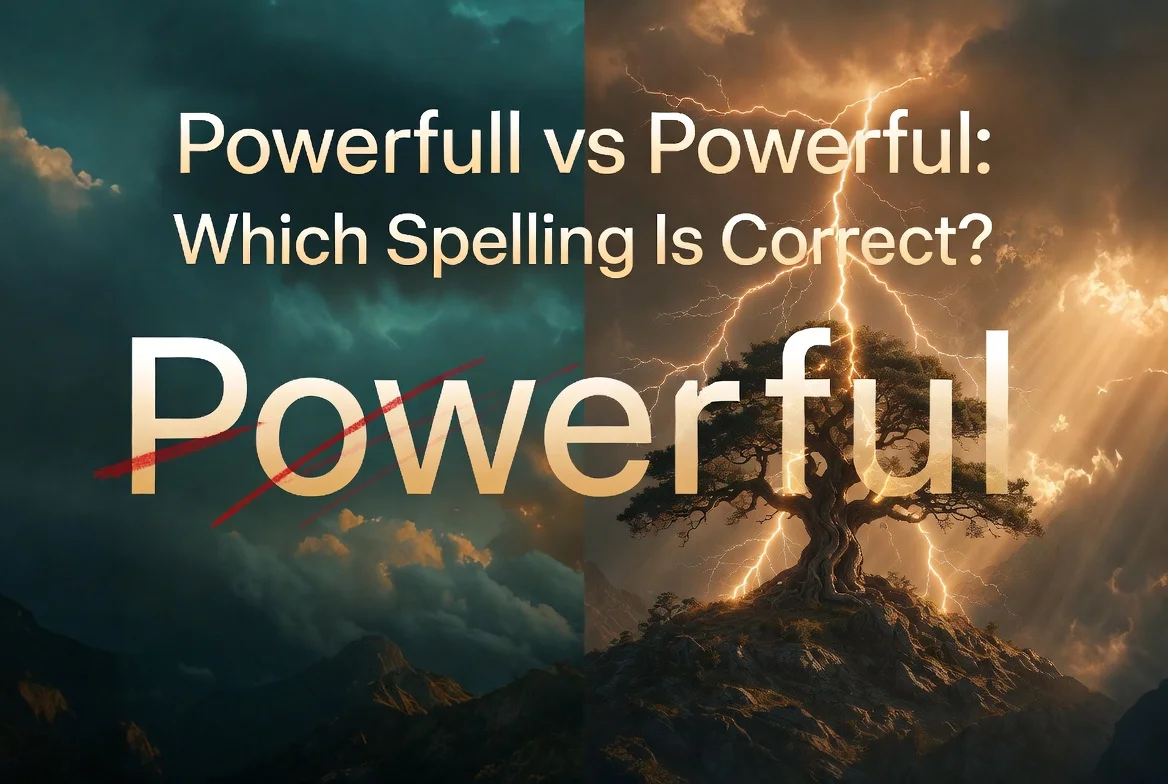
✔ Correct spelling: Powerful
❌ Incorrect spelling: Powerfull
There is no situation in modern standard English where “powerfull” is accepted as correct.
Read more: Convertor vs Converter: Which Spelling Is Correct?
Why only one “l” at the end?
The word follows a common English pattern:
- help → helpful
- beauty → beautiful
- power → powerful
English drops the second “l” when “-ful” becomes an adjective suffix. That suffix means “full of,” but it does not literally keep the word “full” intact.
So instead of writing:
power + full = powerfull ❌
English standardizes it as:
power + ful = powerful ✔
This is not random. It’s a consistent spelling rule across dozens of common adjectives.
Understanding the Word “Powerful” in Real Life
“Powerful” is not just a grammar word. It’s a concept that appears in speech, writing, branding, and everyday conversation.
Meaning of Powerful
At its core, “powerful” means:
Having great strength, influence, or control over something.
But that definition expands depending on context.
Real-world meanings include:
- Physical strength
- A powerful engine
- A powerful storm
- Social influence
- A powerful politician
- A powerful organization
- Emotional impact
- A powerful speech
- A powerful story
- Intellectual force
- A powerful argument
- A powerful idea
So when someone says “that was powerful,” they’re not always talking about strength. They could be talking about impact, emotion, or influence.
The Etymology of “Powerful”: Where the Word Comes From
Understanding the origin makes spelling easier to remember.
Word breakdown:
- Power → strength, ability, control
- -ful → “full of” or “having the quality of”
So historically, “powerful” literally means:
“Full of power”
Linguistic roots:
- “Power” traces back to Old French povoir
- It ultimately connects to Latin potere, meaning “to be able”
English adopted and simplified the structure over centuries.
What’s interesting is that English prefers consistency over literal structure. That’s why we don’t write “powerfull,” even though it might feel logical at first glance.
Why “Powerfull” Is Incorrect in Standard English
Let’s break this down in a simple way.
English adjectives ending in “-ful” follow a fixed spelling rule:
- One “l” only
- No doubling
Common correct “-ful” words:
| Correct Word | Meaning |
| beautiful | full of beauty |
| helpful | full of help |
| careful | full of care |
| powerful | full of power |
Now compare:
| Incorrect Word | Status |
| powerfull | wrong |
| beautifull | wrong |
| helpfull | wrong |
This isn’t a preference. It’s standardized spelling across dictionaries like Merriam-Webster and Oxford English Dictionary.
Why the mistake spreads anyway
People often assume:
- “Full” should stay intact
- Doubling letters looks more “emphasized”
- Autocorrect errors reinforce bad habits
So “powerfull” keeps appearing even though it doesn’t belong in formal writing.
How People Misuse “Powerfull” in Real Life
You’ll mostly see the incorrect spelling in informal or unedited content.
Common places:
- Instagram captions
- YouTube comments
- Small business marketing posts
- Student assignments
- Non-native English writing
Why it spreads so fast online
Here’s the reality:
- Social media encourages fast typing
- Spellcheck tools sometimes fail or are ignored
- People copy text without verifying spelling
So one mistake spreads like a chain reaction.
Example:
A fitness brand writes:
“A powerfull workout routine for beginners”
Another page copies it. Then another. Suddenly, it looks “normal,” even though it’s wrong.
How to Pronounce “Powerful” Correctly
Spelling aside, pronunciation also matters.
Phonetic form:
/ˈpaʊər.fəl/
Natural breakdown:
- pow → like “how”
- er → soft linking sound
- ful → “fuhl” (not “full” clearly stressed)
Common mistakes:
- Saying “power-full” with two strong syllables
- Over-emphasizing the “full” part
- Speaking too slowly and separating sounds unnaturally
Tip to fix it:
Say it quickly like one flowing word:
pow-er-fuhl
Think of it like a wave. Smooth, not broken.
Example Sentences Using “Powerful”
Let’s ground this in real usage.
- The speech was so powerful that the audience stayed silent for minutes.
- She became a powerful voice in environmental activism.
- That small engine is surprisingly powerful for its size.
- His words carried a powerful emotional impact.
- The storm grew more powerful as it moved inland.
Notice something important:
The word adapts to people, things, nature, and abstract ideas.
Synonyms of “Powerful” (With Real Context)
Synonyms help you avoid repetition, but each carries a slightly different tone.
| Synonym | Best Use Case |
| Strong | physical strength or durability |
| Influential | people or organizations |
| Mighty | poetic or dramatic tone |
| Forceful | arguments or speech |
| Potent | chemicals, effects, emotions |
| Effective | results or performance |
Example shift in tone:
- “A powerful argument” → “A forceful argument”
- “A powerful leader” → “An influential leader”
Each word shifts meaning slightly. That’s why context matters.
Antonyms of “Powerful”
To understand a word deeply, you also need its opposite.
| Antonym | Meaning |
| Weak | lacking strength |
| Powerless | no control or influence |
| Fragile | easily broken |
| Ineffective | not producing results |
| Insignificant | lacking importance |
Example contrast:
- Powerful speech → Weak speech
- Powerful nation → Powerless nation
Related Words and Forms
“Powerful” belongs to a word family.
- Power (noun): ability or strength
- Powerful (adjective): having power
- Powerfully (adverb): done with strength or impact
- Empower (verb): to give power
- Empowerment (noun): process of gaining power
Example:
- She spoke powerfully during the debate.
- The program helps empower young women.
Grammar Insight: Why “-ful” Words Follow This Pattern
English often simplifies word endings for smoother writing.
Pattern rule:
Root word + “ful” = adjective meaning “full of X”
Examples:
- hope → hopeful
- joy → joyful
- peace → peaceful
- power → powerful
Why not “full” spelling?
Because English treats “-ful” as a suffix, not the standalone word “full.”
So it becomes:
beautiful, not beautifull
powerful, not powerfull
This is one of those rules that becomes second nature once you see enough examples.
Common Questions About Powerful vs Powerfull
Is “powerfull” a real word?
No. Standard English dictionaries do not recognize it as correct.
Which is correct: powerful or powerfull?
Only powerful is correct in all formal writing.
Why is it powerful and not powerfull?
Because “-ful” is a suffix that never doubles the “l.”
Is “powerful” different in British and American English?
No. Both use the same spelling and meaning.
What does “powerfull” mean in other contexts?
Sometimes people mistakenly use it as:
- A typo
- A non-native spelling variation
- A stylistic error in informal writing
It has no accepted definition in English.
Common Writing Mistakes to Avoid
Even strong writers slip up on small details.
Avoid these:
- Writing powerfull instead of powerful
- Overthinking the suffix “full”
- Mixing spelling from informal online posts
- Trusting autocorrect blindly
Simple rule to remember:
If a word ends in “-ful,” it almost always has one “l.”
Quick Comparison Table: Powerful vs Powerfull
| Feature | Powerful | Powerfull |
| Spelling | Correct | Incorrect |
| Dictionary Status | Standard English | Not recognized |
| Usage | Formal & informal | Error only |
| Meaning | Full of power or influence | No valid meaning |
Case Study: How a Small Spelling Error Affects Credibility
Let’s look at a real-world style scenario.
A startup posts:
“We deliver a powerfull marketing strategy that grows your brand.”
At first glance, the message sounds fine. But a sharp reader spots the error immediately.
What happens next:
- The reader questions professionalism
- Trust drops slightly
- Competitors look more credible
Even if the strategy is excellent, the spelling weakens perception.
Conclusion
The confusion between “Powerfull vs Powerful” usually comes from how English words look rather than how they are actually formed. In real usage, powerful is the only correct spelling, while powerfull is simply a mistake created by wrongly doubling the “l.” Once you understand how suffixes like -ful work, the difference becomes easy to remember and apply in writing.
Good spelling is not just about rules—it directly affects your writing credibility and clarity. When you consistently use the correct form, your English becomes more professional, easier to read, and more reliable in both academic and real-world communication.
FAQs
1. Which is correct: powerfull or powerful?
The correct spelling is powerful. Powerfull is incorrect and not accepted in English dictionaries.
2. Why is “powerfull” wrong?
Because English uses the suffix -ful with only one “l,” so doubling it to “full” breaks spelling rules.
3. What does “powerful” mean?
Powerful means having strength, influence, or control over something.
4. Is “powerfull” ever used in English?
No, it is not a valid English word. It is considered a typo of powerful.
5. How can I avoid this spelling mistake?
Learn common suffix rules like -ful, read dictionary examples, and practice writing regularly to build correct spelling habits.