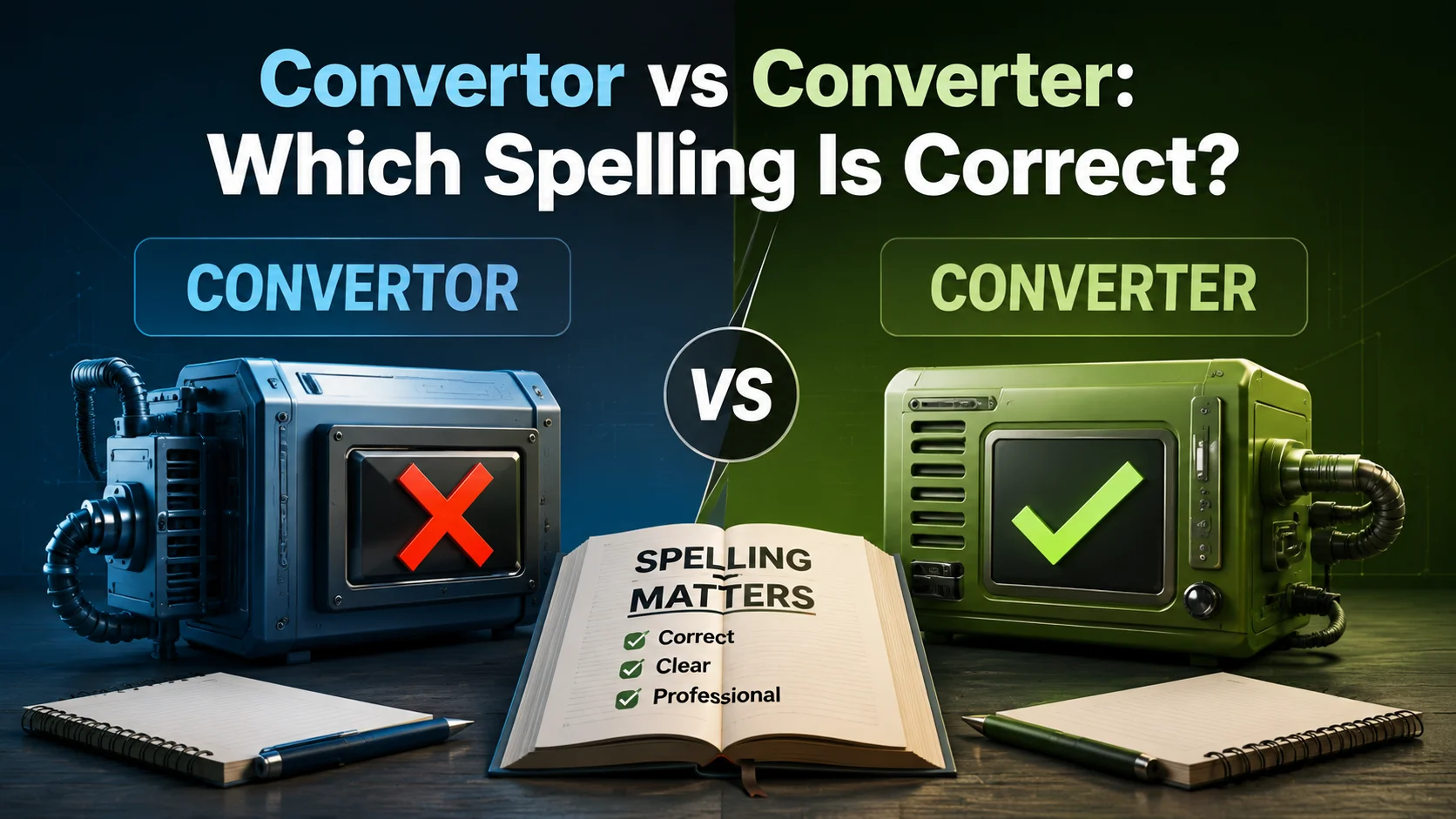
Convertor vs Converter: Which Spelling Is Correct? English spelling confusion in usage among tools apps and devices digital technical context.
In language usage context, Converter and Convertor often confuse people. Writers and professionals consider usage in industry and geography. Many words show subtle differences in writing, depending on definitions, context, and technical applications. Electrical and mechanical fields frequently share examples, while digital tools dominate everyday scenarios. Both forms appear in professional and general writing, but spelling differences still create mistakes. Understanding root meaning helps avoid confusion when discussing devices, apps, and signal-based systems. Meanwhile, professionals guide correct use across scenarios, ensuring accurate and proper writing in industry history and practical examples.
Convertor vs Converter: Why This Confusion Exists in the First Place
At first glance, both words look legitimate. They sound identical. They even appear in similar contexts like engineering, software, and electronics.
So why do two spellings exist?
Here’s what’s really going on:
- English borrowed patterns from Latin and French word formation
- Older technical documents sometimes used alternate spellings
- Some industries kept legacy terminology for decades
- Non-native writing and regional differences reinforced variations
- Search engines index both, even if one is outdated
This mix created long-term confusion that still shows up today.
But modern English has largely standardized the correct form.
And that form is converter.
Read more: Powerfull vs Powerful: Which Spelling Is Correct?
The Correct Standard Spelling: “Converter” Explained Clearly
Let’s make this simple and unambiguous.
Converter is the globally accepted spelling
In modern English, converter is the correct and preferred form across:
- American English
- British English
- Technical documentation
- Academic writing
- Engineering standards
- Software terminology
If you check major dictionaries like Merriam-Webster or Oxford English Dictionary, you will find “converter” listed as the standard noun form derived from the verb “convert.”
Why “converter” is grammatically correct
The structure is straightforward:
- Verb: convert
- Noun form: convert + er = converter
This follows a normal English word-formation rule used in hundreds of words:
- teach → teacher
- build → builder
- mix → mixer
- convert → converter
Nothing unusual. Nothing inconsistent. Just standard grammar at work.
Where you’ll see “converter” in real life
You encounter this spelling everywhere, often without noticing:
- Power converter (voltage or current transformation systems)
- File converter (PDF to Word, image format tools)
- Currency converter (financial exchange tools)
- Catalytic converter (automotive emissions systems)
- Audio converter (digital sound processing tools)
In all these cases, “converter” is the accepted term.
Meaning of Converter: What It Actually Represents
The word “converter” isn’t just grammar. It represents a concept used across multiple fields.
General definition
A converter is something that changes one form, system, or state into another.
That “something” can be:
- A machine
- A software tool
- A chemical process
- A physical device
Simple explanation you can picture
Think of a converter as a translator.
Not of languages—but of systems.
It takes one format and turns it into another that you can use more easily.
Real-world examples that make it clear
Here’s how it works in everyday life:
- A PDF converter turns documents into editable Word files
- A currency converter turns USD into EUR instantly
- A voltage converter adapts electricity for devices
- A video converter changes file formats like MP4 to AVI
Each one performs the same basic function:
It transforms something into a usable alternative form.
That’s the core idea behind the word.
What About “Convertor”? Is It Actually Wrong?
Now let’s talk about the controversial spelling: convertor.
This is where things get interesting.
Convertor is not standard in modern English
Most modern dictionaries and style guides do not recommend “convertor” as the correct spelling.
Instead, they classify it as:
- An alternative spelling
- An archaic variant
- A non-standard form
In everyday writing, especially professional or academic contexts, it is considered incorrect or outdated.
Where “convertor” still appears
Even though it’s not standard, you might still see it in:
- Older engineering documents
- Legacy industrial manuals
- Historical patents
- Regional or inconsistent publications
- Brand names that intentionally chose alternative spelling
So it’s not “made up,” but it is no longer preferred.
Why it hasn’t completely disappeared
Language doesn’t update overnight.
Once a spelling enters usage, it can linger for decades due to:
- Archived documents still circulating online
- Engineers and technicians referencing older manuals
- SEO content that wasn’t updated
- Human habit and repetition
So while “convertor” exists, it survives mostly in older or inconsistent contexts.
Convertor vs Converter: Side-by-Side Comparison
To make things crystal clear, here’s a direct comparison.
| Feature | Converter | Convertor |
| Modern usage | Standard worldwide | Rare and outdated |
| Dictionary acceptance | Yes (universally accepted) | Limited or marked variant |
| Technical writing | Correct form | Avoided |
| SEO performance | High search relevance | Low search intent |
| Academic usage | Preferred | Not recommended |
| Industry standards | Fully aligned | Not standard |
This table alone tells you everything you need to know.
Grammar Rule Behind the Correct Form
Let’s break down why “converter” wins linguistically.
Step-by-step formation
- Start with the verb: convert
- Add the agent suffix: -er
- Form the noun: converter
This follows one of the most common English noun patterns.
Why “convertor” feels wrong to linguists
English doesn’t typically change “-er” formations into “-or” unless historically established.
For example:
- actor (Latin origin)
- doctor (Latin origin)
- creator (from create)
But “convert” is Germanic/modern English in structure, so it follows the -er rule, not the Latin-derived -or rule.
Simple analogy
Think of it like this:
- You don’t say “buildor”
- You don’t say “teachor”
- So you don’t say “convertor” either
It breaks the natural flow of English word formation.
When You Might Still See “Convertor” in Use
Even though it’s outdated, it still appears in specific places.
Common scenarios
- Old engineering textbooks still in circulation
- Archived technical PDFs on the web
- Non-updated industrial documentation
- Small businesses using legacy branding
- Non-native English writing errors
Important insight
Seeing it doesn’t make it correct—it just reflects history or inconsistency.
Why Choosing the Right Spelling Matters in Writing and SEO
This is where things get practical.
If you’re writing content online, spelling affects visibility.
Why “converter” performs better online
Search engines prioritize:
- Common usage
- User search behavior
- Standard dictionary forms
And users overwhelmingly type:
- “currency converter”
- “pdf converter”
- “video converter”
Not “convertor.”
SEO impact comparison
| Factor | Converter | Convertor |
| Search volume | High | Very low |
| Ranking potential | Strong | Weak |
| Keyword intent match | Accurate | Misaligned |
| User trust | High | Lower |
Simple takeaway
If you use “convertor,” you risk:
- Lower traffic
- Confused readers
- Missed keyword opportunities
If you use “converter,” you align with how people actually search.
Case Study: Real Search Behavior Shows the Truth
Let’s look at real-world behavior patterns from search engines.
When users look for tools online, they consistently type:
- “currency converter online”
- “image converter free”
- “file converter pdf to word”
Almost never:
- “currency convertor”
- “file convertor tool”
What this tells us
User behavior strongly confirms that:
“converter” is the dominant and expected spelling in digital environments.
This is why software companies, SaaS tools, and tech platforms consistently use “converter” in their branding.
Expert Insight: What Linguists and Style Guides Agree On
Language experts consistently treat “converter” as the standard form.
Style conventions across professional writing emphasize:
- Consistency with verb-based noun formation
- Preference for modern usage over archaic variants
- Alignment with digital search language
Conclusion
The confusion between Convertor and Converter mainly comes from different usage in writing and technical contexts. In modern English, Converter is the more widely accepted spelling in everyday language, especially for digital tools, apps, and general use. However, Convertor still appears in some technical and electrical fields, even though it is often considered less standard. Understanding this small but important spelling difference helps improve accuracy in professional writing and avoids common mistakes in communication.
FAQs
1. What is the correct spelling: convertor or converter?
Converter is generally the correct and most widely accepted spelling in modern English.
2. Is convertor a wrong spelling?
Not completely. Convertor is used in some technical or industry-specific contexts, but it is less common.
3. Where is the word converter mostly used?
It is mostly used in digital tools, software, apps, and everyday English writing.
4. Why do people get confused between convertor and converter?
The confusion happens because both words have the same meaning and appear in different technical and general contexts.
5. Can I use convertor in professional writing?
It is better to use converter in professional writing unless a specific technical field requires otherwise.