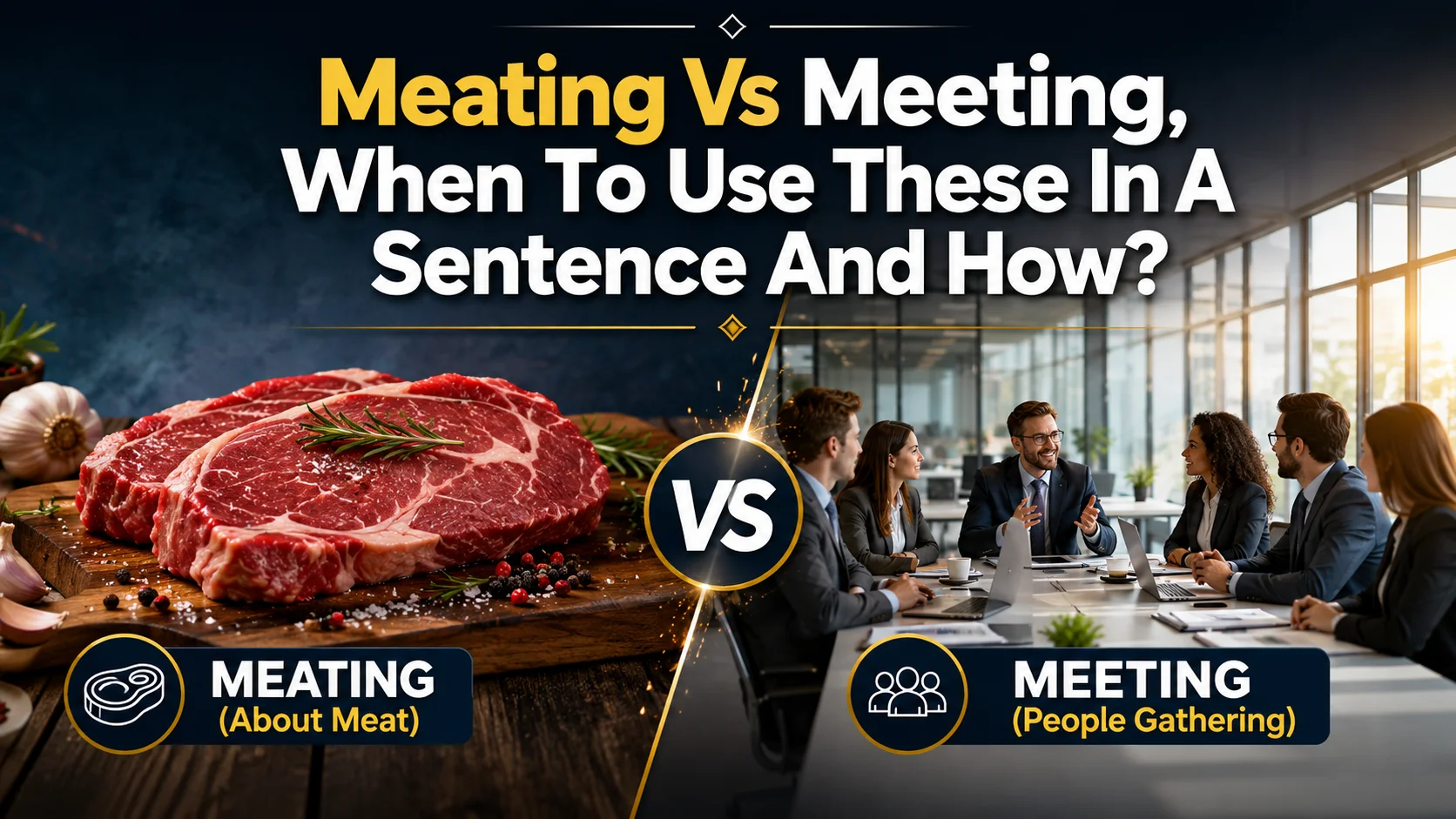
Meating Vs Meeting, When To Use These In A Sentence And How? explains how confusing English words impact writing, speech, and daily usage clarity.
English shows how confusing words affect learners and even native speakers, especially when they wonder about tricky examples where words sound identical but carry different meaning and usage. The difference and understanding of this difference helps improve communication, avoid spelling mistakes, and sound professional in writing and speech. In daily life, people often explore this detail, and such Confusing situations like meating vs meeting become one of the most common mistakes in English writing, yet it is easy to avoid when you understand usage.
A meeting refers to a discussion such as a business meeting, Google meeting, or casual team huddle, where a meeting is a gathering of people to exchange ideas, discuss topics, and make decisions. On the other hand, meating is a mistaken word, a common misspelling, that can confuse readers, is used incorrectly, and has no place in official English. Its origin, mastering of terms, and proper usage in daily life helps explore every detail, making writing more precise, professional, and grammatically correct.
Meeting vs Meating: Why This Confusion Even Exists
At first glance, this looks like a simple typo issue. However, language rarely works that cleanly.
People confuse meeting vs meating mainly because:
- They sound identical when spoken
- Fast typing leads to missed letters
- “Meat” is a very common word, so the brain interferes
- Auto-correct sometimes fails in messy drafts
- English spelling rules don’t always match pronunciation
Here’s the funny part: your brain tries to “fix” words based on familiarity. Since meat is a real word, your fingers may accidentally build on it and produce meating.
But English doesn’t work that way.
Read more: Seing Vs Seeing, What’s The Correct Spelling To Use?
What Does “Meeting” Mean in English? (Clear Definition)
The word “meeting” comes from the verb meet. It describes people coming together for a purpose.
In modern English, “meeting” works in two main ways:
As a noun
A meeting is an organized gathering.
Examples:
- A business discussion
- A school conference
- A group decision session
As a verb form (present participle)
“I am meeting my friend” means the action is happening now or in the future.
Real-world examples of “meeting”
- “We have a meeting with the client at 3 PM.”
- “The meeting lasted over two hours.”
- “She is meeting the new manager today.”
Notice something important here: every example involves people interacting or planning together.
That’s the core idea.
Is “Meating” a Real Word in English?
Let’s clear this up directly.
👉 In standard English, “meating” is NOT a correct word for meetings or gatherings.
However, there are rare situations where people may see it or use it:
1. Related to “meat” (food context)
Technically, “meating” could appear as:
- Slang in informal writing
- A playful or invented word
- Rare industrial jargon (not standard English)
But even then, it is extremely uncommon and not accepted in formal grammar.
2. Typing and spelling errors
Most of the time, “meating” appears because:
- Someone missed the second “e” in “meeting”
- Autocorrect guessed incorrectly
- A speaker typed too fast
Key takeaway:
If you’re talking about gatherings, discussions, or appointments, always use “meeting.”
Meeting vs Meating: Side-by-Side Comparison
Let’s simplify the difference visually.
| Feature | Meeting | Meating |
| Standard English word | Yes | No |
| Meaning | A gathering or appointment | No correct meaning in this context |
| Usage in writing | Formal and informal | Incorrect in formal writing |
| Verb form | Yes (“meeting someone”) | Not valid |
| Commonality | Very common | Rare / error |
This table alone explains why “meating” should almost never appear in writing.
Origins of the Word “Meeting” (Etymology Explained Simply)
To really understand why “meeting” exists, we need to go back in time.
The word comes from the Old English root “mētan”, meaning to meet or come together.
Over time:
- Old English: mētan (to meet)
- Middle English: meting / meeting
- Modern English: meeting
The “-ing” ending evolved naturally as English developed rules for describing ongoing actions and nouns derived from verbs.
So when you say “meeting,” you are literally using a word built from centuries of language evolution.
What about “meat”? Where does it come from?
This is where confusion starts.
The word “meat” originally came from Old English “mete”, meaning food in general, not just animal flesh.
Over time:
- “Meat” narrowed in meaning to animal protein
- “Meet” stayed focused on coming together
So even though “meat” and “meet” sound similar today, they come from completely different linguistic roots.
That’s why combining them into “meating” doesn’t make grammatical sense.
When to Use “Meeting” in Real Life (Practical Guide)
Let’s make this useful in real situations.
You use meeting whenever people come together for a purpose.
Common contexts:
Workplace
- Team meetings
- Client meetings
- Project discussions
Education
- Parent-teacher meetings
- Academic conferences
- Student group meetings
Personal life
- Friends planning events
- Community discussions
- Online video calls
Examples that feel natural
- “We scheduled a meeting to discuss the budget.”
- “The meeting got postponed due to weather issues.”
- “I’m meeting my cousin after work.”
Notice how flexible the word is. It fits both formal and casual situations.
Why People Write “Meating” by Mistake
This mistake is more common than you think.
Let’s break down the real causes:
1. Fast typing habits
When typing quickly, people often skip letters. “Meeting” becomes “meating” instantly.
2. Sound-based spelling
English is not phonetic. Words are not always spelled how they sound. So people write what they hear.
3. Brain interference from familiar words
Since “meat” is a common word, your brain sometimes inserts it unconsciously.
4. Auto-correct limitations
Auto-correct doesn’t always catch subtle errors, especially if both words look “valid” structurally.
Real-world case example
A small business email error once circulated internally in a company where “team meeting” was written as “team meating.”
The result?
- Confusion in scheduling
- A humorous misunderstanding among employees
- Temporary delay in meeting confirmation
This shows how even small spelling errors can affect communication clarity.
Common Mistakes You Should Avoid
Let’s clean up the biggest pitfalls.
Don’t write:
- “We have a meating tomorrow.”
- “I am meating the client.”
- “Let’s plan a meating.”
Instead, write:
- “We have a meeting tomorrow.”
- “I am meeting the client.”
- “Let’s plan a meeting.”
Subtle mistake: mixing meanings
Some learners also confuse “meeting” with food-related contexts because of “meat.”
But remember:
- Meeting = people
- Meat = food
They live in completely different worlds.
Easy Memory Tricks to Never Confuse Them Again
Here are simple mental shortcuts:
Trick 1: Word pairing
- Meet → Meeting
- Meat → Food only
Trick 2: Sentence logic
Ask yourself:
“Are people coming together?”
If yes → use meeting
Trick 3: Visual association
- Meeting = people sitting around a table
- Meat = something on a plate
Your brain remembers images better than rules.
Practice Section: Fix the Sentence
Try correcting these:
Example 1
❌ “We are having a meating at 5 PM.”
✔ “We are having a meeting at 5 PM.”
Example 2
❌ “She is meating her boss today.”
✔ “She is meeting her boss today.”
Example 3
✔ “The meeting went smoothly.” (Already correct)
Mini Grammar Insight: Why English Spelling Feels Tricky
English borrows from many languages:
- Latin
- French
- Germanic roots
That means spelling doesn’t always follow sound patterns.
That’s why:
- “through” and “though” look similar but sound different
- “meet” and “meat” sound similar but mean different things
So mistakes like “meating” are completely understandable.
Conclusion
Understanding Meating Vs Meeting, When To Use These In A Sentence And How? is important if you want your English writing to stay clear, correct, and professional. A meeting always refers to a real gathering of people where ideas are shared, while meating is simply a common misspelling with no official meaning in English. Knowing this difference helps improve communication, avoids spelling mistakes, and prevents confusion in both speech and writing. With regular attention to usage, even tricky confusing words like this become easy to manage in daily life.
FAQs
1. What is the meaning of “meeting”?
A meeting is a gathering of people to discuss topics, exchange ideas, or make decisions, such as a business or online meeting.
2. Is “meating” a real English word?
No, meating is not a standard English word. It is a common spelling error of “meeting.”
3. Why do people confuse meating and meeting?
People confuse them because they are confusing words that sound identical, leading to mistakes in writing and speech.
4. How can I avoid this mistake?
You can avoid it by remembering that meeting relates to people and discussion, while meating has no meaning in official English.
5. Can using “meating” affect professional writing?
Yes, using meating can make writing look careless and reduce professional credibility, especially in emails or workplace communication.