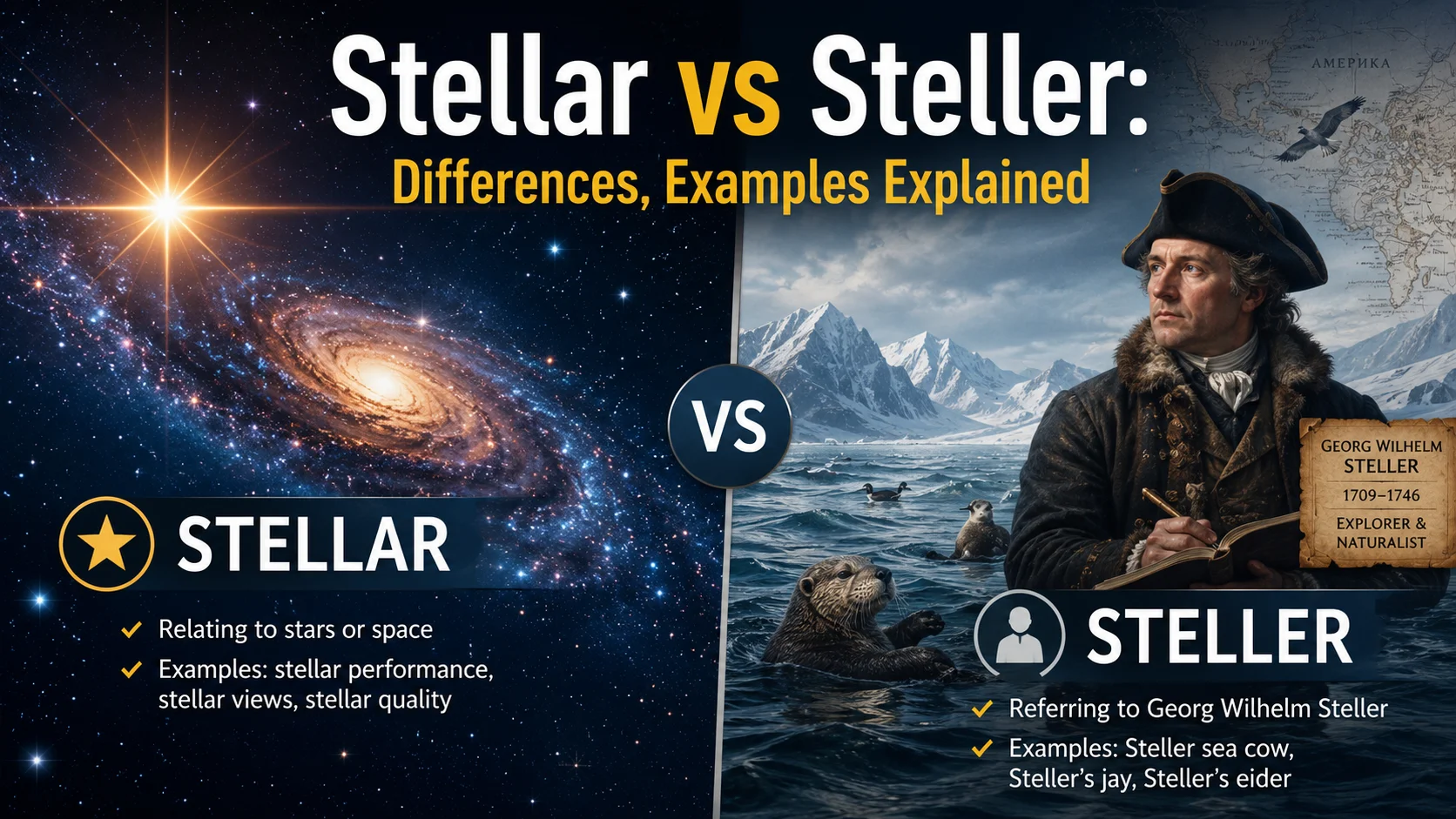
Stellar vs Steller: Differences, Meaning, Usage, Examples Explained is a topic I often notice in my experience with English grammar, where one of the most commonly mixed word pairs is Stellar vs Steller, creating confusion for people because both words look almost identical at first glance. This issue appears especially when learners make a small typo or spelling mistakes, which can easily change meaning and lead to confused readers, affecting clear writing, language clarity, and grammar accuracy in English context.
I have seen Many writers and learners search steller vs stellar difference, because the issue is not just appearance but also correct usage in real writing situations where even lead confused readers becomes a problem in blog posts, emails, and professional writing.
Stellar vs Steller: Why These Two Words Cause So Much Confusion
At first glance, the difference feels almost invisible. You only spot it when you slow down and look closely. The issue comes from pronunciation. Both words sound the same in most English accents, so your brain doesn’t naturally flag the spelling difference.
However, the meanings live in completely different worlds.
- Stellar belongs to everyday English and describes quality or stars.
- Steller belongs mostly to scientific naming and proper nouns.
Here’s the twist: most people never encounter “Steller” unless they read biology texts or wildlife content. That makes them assume it’s just a misspelling of “stellar.” But that assumption leads to one of the most common writing mistakes online.
Read more: Oversite Vs Oversight: When To Use Each One In Writing?
Core Difference Between Stellar and Steller
Let’s strip everything down to the essentials. You don’t need complicated grammar theory here. You just need clarity.
| Word | Type | Meaning | Usage Level | Example Context |
| Stellar | Adjective | Excellent, outstanding, related to stars | Very common | “She gave a stellar performance.” |
| Steller | Proper noun | Named after naturalist Georg Steller | Rare | “Steller’s sea lion lives in the Pacific.” |
The key takeaway is simple:
👉 Stellar describes quality.
👉 Steller identifies names in science.
If you remember just that, you already avoid 90% of mistakes.
What “Stellar” Really Means in Modern English
The word “stellar” comes from the Latin stella, meaning “star.” Over time, English speakers expanded its meaning beyond astronomy.
Today, “stellar” carries two main uses:
1. Literal meaning (astronomy-related)
Writers use it when talking about stars or space.
Example:
- Stellar formation refers to how stars form in space.
2. Figurative meaning (most common use)
This is where you see it in everyday language. It describes something outstanding.
Example:
- Stellar job performance means excellent work.
You’ll hear it in business, sports, education, and entertainment. It has become a strong compliment word.
Quick meaning snapshot
- Stellar = excellent, top-tier, impressive
- Stellar = also related to stars in science
Real-world usage examples
- “That was a stellar presentation in class.”
- “She has a stellar reputation in the industry.”
- “The team delivered a stellar performance under pressure.”
Notice something? It always signals positivity and high quality.
What “Steller” Actually Means (And Why It Exists)
Now let’s switch gears.
“Steller” doesn’t describe quality at all. Instead, it comes from Georg Wilhelm Steller, a German naturalist from the 18th century. Scientists named several animals after him.
That’s why you see terms like:
- Steller’s sea lion
- Steller’s sea eagle
- Steller’s jay
These are real species names used in biology and conservation studies.
Important fact
You almost never use “Steller” outside scientific or naming contexts. It is not a descriptive English word.
Where you’ll actually see it
- Wildlife documentaries
- Biology textbooks
- Research papers
- Conservation reports
Example:
- “The Steller’s sea eagle is one of the largest birds of prey in the world.”
Here, “Steller’s” is not describing anything as good or bad. It simply identifies a species.
Pronunciation: Why People Get Tricked
Here’s where things get sneaky.
Both words sound almost identical:
- Stellar → /ˈstɛlər/
- Steller → /ˈstɛlər/
That’s right. In spoken English, they are basically indistinguishable.
So when someone hears the word in conversation, they often assume the spelling. That leads to writing mistakes like:
- “Steller performance” ❌
- “Stellar performance” ✔️
This is why spelling awareness matters more than pronunciation in this case.
How to Use “Stellar” Correctly in Sentences
You can think of “stellar” as a high-energy compliment word. It boosts anything it describes.
Common usage patterns
- Stellar + performance
- Stellar + reputation
- Stellar + results
- Stellar + achievement
Examples in real context
- “He delivered a stellar performance in the final match.”
- “The company has a stellar track record in innovation.”
- “She built a stellar career in marketing.”
Simple rule
If you’re praising something, you almost always want stellar.
How to Use “Steller” Correctly in Sentences
“Steller” behaves very differently. You don’t use it to describe quality. You use it to identify something specific in biology.
Correct usage patterns
- Steller’s + animal name
- Scientific references
- Species identification
Examples
- “Steller’s sea lion lives along the North Pacific coast.”
- “Steller’s jay is known for its bold behavior.”
- “Researchers studied the migration of Steller’s sea eagle.”
Simple rule
If it looks like a name in biology, it’s likely Steller.
Real Examples of Stellar vs Steller in Action
Let’s put both words side by side so you can clearly see the difference.
Stellar examples (quality-based)
- “That restaurant gave us a stellar dining experience.”
- “The athlete showed stellar endurance during the marathon.”
- “Her essay received stellar feedback from the professor.”
Steller examples (scientific naming)
- “The Steller’s sea lion can weigh over 2,000 pounds.”
- “Steller’s jay often imitates other bird calls.”
- “Scientists tracked Steller’s sea eagle populations for decades.”
Quick comparison table
| Sentence Type | Correct Word | Why |
| Praise performance | Stellar | Describes quality |
| Wildlife species | Steller | Proper scientific name |
| Business review | Stellar | Figurative excellence |
| Biology report | Steller | Naming convention |
Common Mistakes People Make
Even native speakers slip up. The most common errors come from assumptions, not ignorance.
Mistake patterns
- Writing “steller performance” in reviews
- Assuming both words are interchangeable
- Copying spelling from speech without verification
Why it happens
- Same pronunciation
- Lack of exposure to scientific usage
- Overuse of “stellar” in modern slang
Using Stellar Instead of Steller (and Why It Breaks Meaning)
This is the most common mistake in writing.
When you write:
- “Stellar’s sea lion” ❌
You accidentally turn a scientific name into a compliment word. That changes the meaning completely.
Correct form:
- “Steller’s sea lion” ✔️
Using Steller Instead of Stellar
This mistake looks small but feels wrong to readers.
Example:
- “She did a steller job” ❌
This weakens your writing because “steller” doesn’t carry meaning in English praise vocabulary.
Correct:
- “She did a stellar job” ✔️
Mixing Both Words Interchangeably
Some writers assume spelling doesn’t matter. But here it changes meaning entirely.
If you mix them:
- You confuse readers
- You weaken credibility
- You break grammar accuracy
Why Context Matters More Than Memory
Instead of memorizing blindly, use context clues.
Ask yourself:
- Am I describing quality? → Use stellar
- Am I naming a species? → Use steller
This decision takes less than a second once you practice it.
Memory Tricks That Actually Work
Here are simple tricks that stick:
- Stellar = “A for Amazing” → It has an “A” in it
- Steller = “Name label” → Think of museum or biology tags
- Stellar = stars (space + excellence)
- Steller = scientist’s surname
These mental shortcuts reduce mistakes instantly.
Exceptions and Special Cases
Even though rules stay consistent, a few edge cases exist.
Proper nouns
Any species or named object stays “Steller”:
- Steller’s sea lion
- Steller’s sea eagle
Scientific naming conventions
Taxonomy follows strict naming rules, so spelling never changes for style.
Capitalization matters
- “Steller’s” is always capitalized when used in species names.
Quick Editing Checklist for Writers
Before publishing anything, run through this mental checklist:
- Did I mean praise or a species name?
- Did I accidentally swap “a” and “e”?
- Does the word fit the context logically?
- Is capitalization correct for proper nouns?
This quick scan prevents most errors instantly.
Practice Exercises to Lock It In
Try these quick challenges:
Fill in the blank
- She gave a ______ performance at the concert.
- The ______ sea eagle hunts fish near coastal cliffs.
Answer key
- Stellar
- Steller
Spot the mistake
- “He delivered a steller presentation.”
- “Stellar’s jay is a colorful bird.”
Correct them:
- Stellar presentation ✔️
- Steller’s jay ✔️
Conclusion
Understanding Stellar vs Steller is important because both words look similar but have completely different meanings. Stellar is used for something outstanding or related to stars, while Steller is a proper noun linked to Georg Wilhelm Steller and certain wildlife species. Mixing them can affect clarity, grammar accuracy, and overall writing credibility, especially in professional or digital communication. When you remember the context—stars vs names—you can avoid most common spelling mistakes and use both terms correctly with confidence.
FAQs
1. What is the main difference between Stellar and Steller?
Stellar means outstanding or related to stars, while Steller is a proper noun linked to a scientist and animal species.
2. Is “steller” a correct English word?
Yes, but only as a proper noun. It is not the same as stellar, which is the common adjective.
3. Why do people confuse Stellar and Steller?
People confuse them because they are almost identical in spelling and sound, leading to common typing mistakes.
4. Where is the word Stellar commonly used?
Stellar is used in astronomy, performance descriptions, and everyday language to mean excellent or outstanding.
5. Who is Georg Wilhelm Steller?
He was a German naturalist after whom the term Steller is used in names of certain wildlife species like the Steller sea lion.