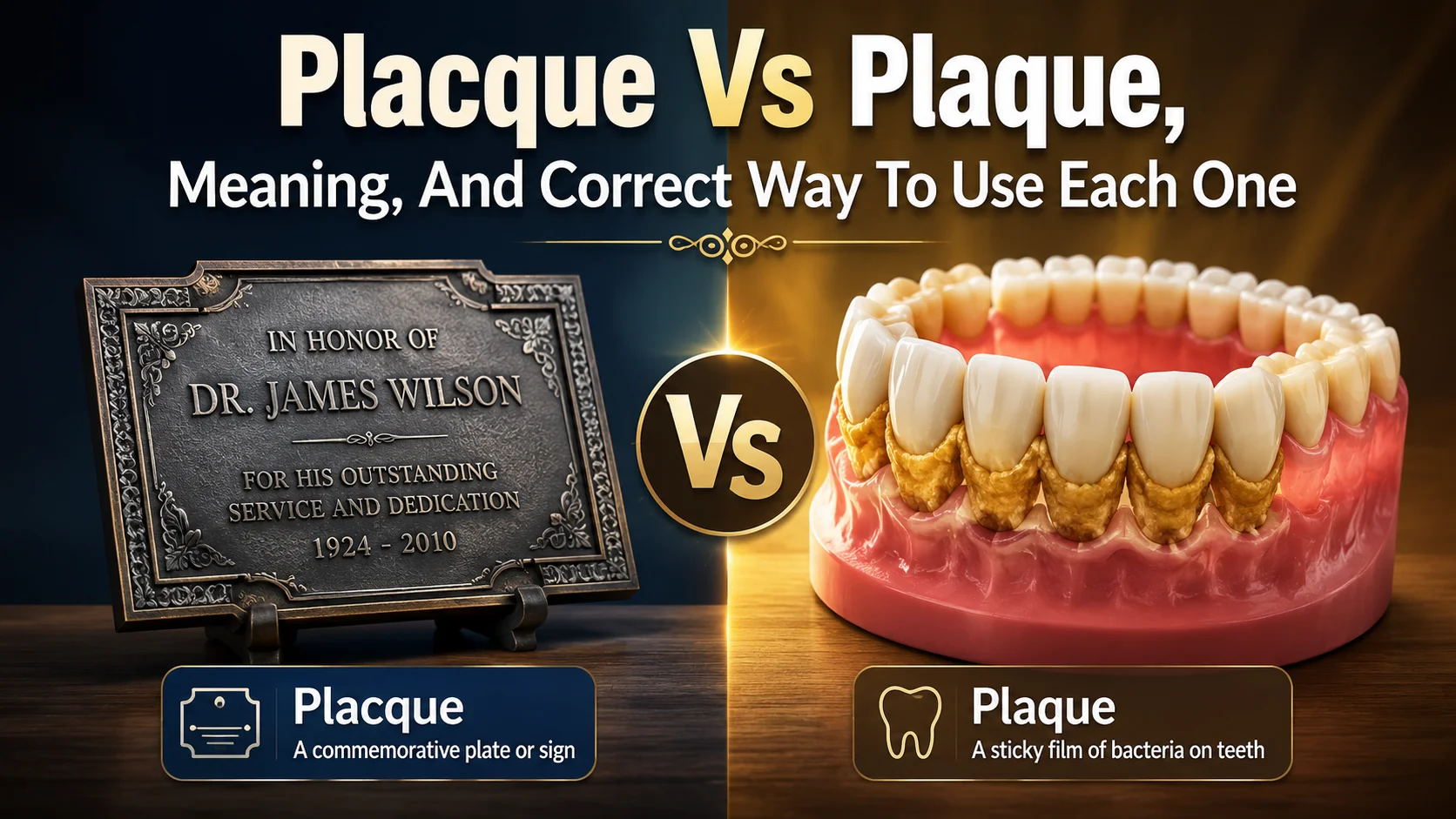
In my experience with writing, I have seen many people getting confused due to confusion between placque and plaque, which creates a common issue in english article usage. The correct and standard word is always plaque, while placque is only a misspelling caused by error, mistake, and unintentionally mixing letters, leading to second-guessing and reduced confidence when assuming both are acceptable. This difference is important in context, especially when improving communication for write and speak skills.
The origin of plaque shows its real meaning in usage like a metal or wooden badge, or sticky bacteria on teeth, while placque has no real meaning or context in english. When I once questioned this while writing, I had to explain and guide myself to fully understand the difference. Through examples in life, we learn and gain good understanding that improves spelling, making communication more properly, clearly, and accurately, without feeling unsure in real usage.
Why “Placque vs Plaque” Is a Common Confusion
The confusion happens for a few simple reasons:
- The word looks French (and it is)
- English speakers often guess the spelling
- The “-que” ending feels like it needs an extra “c”
- People hear it more than they see it written
Because of this, “placque” shows up in search engines, social media, and even informal writing.
However, in standard English:
✔ Plaque = correct spelling
✘ Placque = incorrect spelling
Even dictionaries confirm that “placque” is just a spelling error, not a separate word.
RRead more: Jynx vs Jinx: When To Use Each One In Writing
Meaning of “Plaque” in English
The word plaque has multiple meanings depending on context. It is not limited to one field.
General Meaning
A plaque is typically:
- A flat, thin object
- Often used for display, marking, or identification
For example:
- A wall plaque honoring someone
- A decorative nameplate on a building
Medical Meaning
In medicine, plaque refers to:
- A buildup of unwanted material in the body
- Usually sticky or hardened over time
This includes:
- Dental plaque on teeth
- Arterial plaque in blood vessels
- Brain plaque in conditions like Alzheimer’s disease
According to medical references, plaque can describe multiple biological deposits depending on location in the body .
Dental Plaque Explained Clearly
One of the most common uses of the word is in dentistry.
What is dental plaque?
Dental plaque is:
- A soft, sticky film
- Made of bacteria, saliva, and food particles
- Constantly forming on your teeth
A trusted medical explanation describes it as a bacterial film that builds up on teeth and can lead to gum disease if not removed .
What happens if you don’t remove it?
Plaque doesn’t stay soft forever. It can harden into tartar.
That leads to:
- Cavities
- Gum infections
- Bad breath
- Tooth decay
So when dentists tell you to brush and floss, they’re really telling you to break up plaque before it becomes dangerous.
Origin of the Word “Plaque”
Let’s go back in time for a moment.
The word plaque comes from French plaque, meaning:
- Flat plate
- Sheet of metal
- Thin surface
Even further back, it links to Middle Dutch words meaning “patch” or “piece.”
Over time, English adopted the word and expanded its meaning.
Timeline of meaning expansion
- 15th–17th century: Flat plates and decorative surfaces
- 19th century: Memorial and honor plaques
- Late 19th century: Medical usage begins (arterial plaque)
- Modern use: Dental plaque becomes common
So the meaning shifted from physical plates → to deposits in the body.
How People Commonly Use the Word “Plaque”
Today, people use the word in three main areas:
1. Dental context
- “Brush your teeth to remove plaque.”
- “The dentist cleaned plaque buildup.”
2. Medical context
- “Artery plaque increases heart risk.”
- “Brain plaques are linked to Alzheimer’s disease.”
3. Honorary or decorative context
- “He received a plaque for service.”
- “A bronze plaque marks the historical site.”
Each usage shares one idea: a layer, surface, or marker that sticks or stays in place.
What Type of Word Is “Plaque”?
Let’s get grammatical for a moment—but keep it simple.
Plaque is a noun.
Depending on context, it can be:
Concrete noun
- A physical object
Example: a wall plaque
Medical noun
- A biological deposit
Example: dental plaque
Countable or uncountable
- Countable: “two plaques on the wall”
- Uncountable: “plaque on teeth”
So the word is flexible, but always a noun.
Examples of “Plaque” in Real Sentences
Here’s how the word naturally appears in English:
- “The museum installed a plaque near the entrance.”
- “Plaque buildup can damage your teeth over time.”
- “Doctors found plaque in his arteries during the scan.”
- “She received a plaque for outstanding performance.”
Notice something important here:
👉 The word changes meaning based on context, not spelling.
Common Mistakes People Make
Many writers accidentally confuse or misuse the word. Let’s fix that.
Mistake 1: Writing “placque”
- Incorrect spelling
- No meaning in English
Mistake 2: Thinking plaque is only dental
- Wrong
- It also applies to medicine and awards
Mistake 3: Confusing plaque with tartar
- Plaque = soft bacterial layer
- Tartar = hardened plaque
Quick Comparison Table
| Word | Correct? | Meaning | Usage |
| Plaque | Yes | Deposit, plate, or marker | Medical, dental, honorary |
| Placque | No | None (misspelling) | Not used in English |
Pronunciation of “Plaque”
This word is simple to say:
Plaque = /plæk/ (rhymes with “black”)
Key point:
- No “que” sound
- No extra syllable
People often overthink it, but it’s actually very short.
Why This Word Matters More Than You Think
You might think spelling doesn’t matter much, but in this case it actually does.
Using the correct word:
- Improves clarity in medical communication
- Avoids confusion in academic writing
- Helps SEO and search accuracy
- Builds credibility in professional writing
Even dentists, doctors, and researchers rely on precise usage.
Case Study: Why “Plaque” Matters in Dentistry
Let’s look at a real-world scenario.
A patient visits a dentist complaining of bleeding gums. The dentist explains:
- The issue is plaque buildup
- The patient assumed it was just “food stuck on teeth”
- In reality, it’s a bacterial biofilm causing inflammation
After proper brushing techniques and cleaning:
- Plaque levels drop significantly
- Gum health improves
- Bleeding stops within weeks
This shows how understanding the word directly connects to health behavior.
Simple Rule to Remember Forever
Here’s the easiest way to never forget:
Plaque = real word (think “plate” or “deposit”)
Placque = typo (just ignore it)
If you stick to that rule, you’ll never make the mistake again.
Conclusion
Understanding Placque Vs Plaque, Meaning, And Correct Way To Use Each One is simple once you remember one rule: only plaque is correct in English. The word placque is just a misspelling that appears due to typing errors or confusion in spelling. Whether you are writing about a metal badge, a wooden plaque, or bacteria on teeth, the correct term remains the same. Learning this small difference improves your writing accuracy, builds confidence, and helps you avoid common English mistakes in everyday communication.
FAQs
1. What is the correct spelling: placque or plaque?
The correct spelling is plaque. “Placque” is incorrect.
2. What does plaque mean?
Plaque can mean a metal or wooden badge with writing or sticky bacteria on teeth.
3. Why do people write placque instead of plaque?
It happens due to spelling confusion, typing errors, and misunderstanding of pronunciation.
4. Is placque ever used in English?
No, placque has no meaning and is not a valid English word.
5. How can I avoid this mistake?
By remembering that only plaque is correct and practicing its usage in writing and reading.