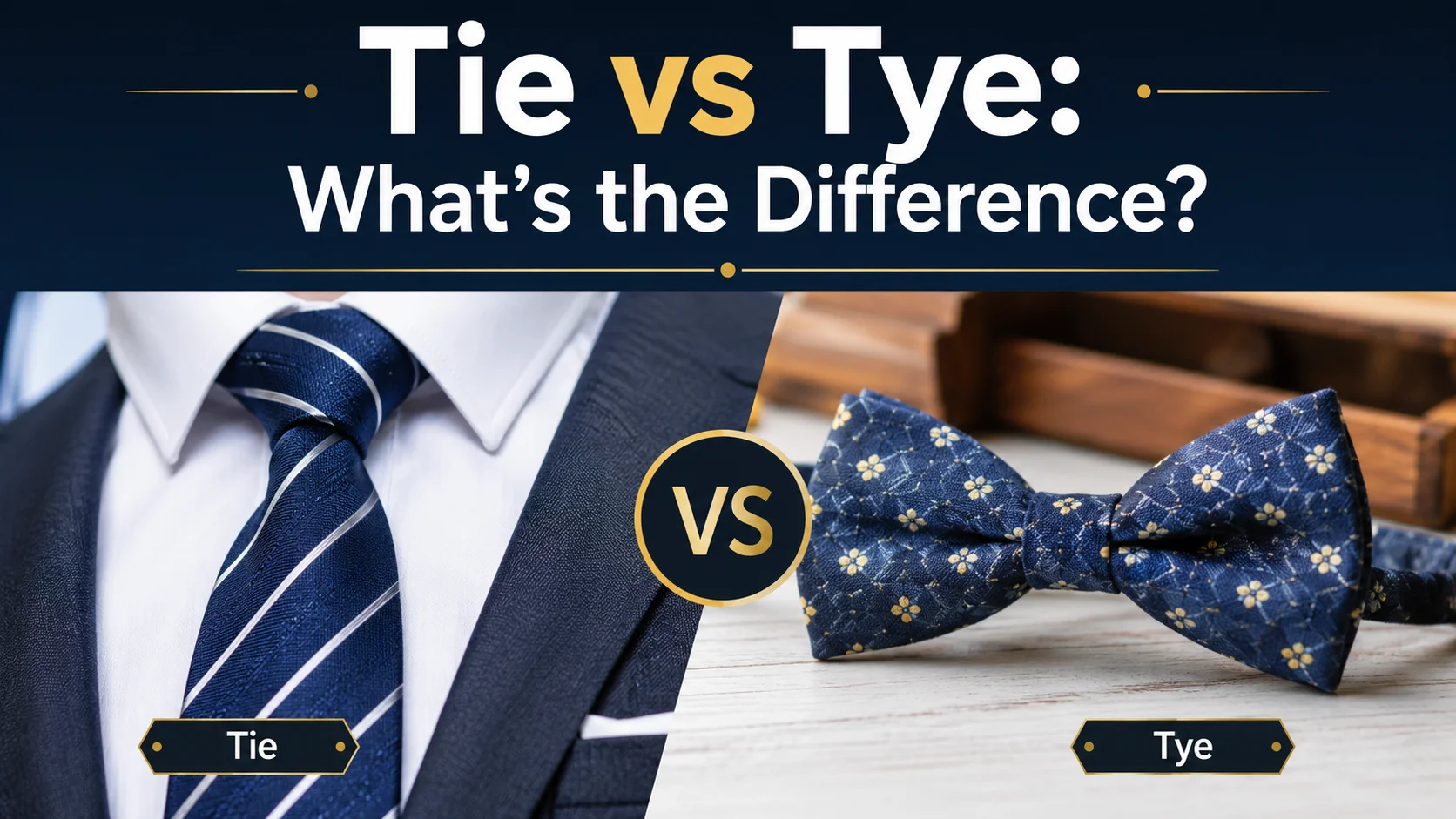
Tie vs Tye: What’s the Difference? explains the difference between tie and tye, helping you choose the correct word with confidence in English.
Many people have wondered why these words create confusion. This guide explores their meaning, meanings, usage, and practical usage in modern English. The word tie is the correct word in most cases, while tye appears mainly in historical records, place names, and surnames. Looking at the context makes it easy to recognize the right choice. I have come across this pair multiple times while editing written English, and the distinction becomes clear after checking the sentence.
Even though tie and tye sound the same when spoken, they are homophones with identical pronunciation but different spelling. Using the wrong form can cause spelling mistakes. For instance, schools, offices, sports, broadcasts, newspapers, books, and everyday conversations almost always use tie because it follows accepted grammar, grammar rules, and standard vocabulary. Paying attention to the correct spelling reduces common errors in writing, while learning the origins, reviewing examples, and understanding the frequency of each spelling help you know more than simple random recognition of a particular word. This article makes mistakes completely avoidable.
Tie vs Tye: The Difference at a Glance
Here is the simplest way to think about it:
- Tie is a real, common English word.
- Tye is usually a name or another proper noun.
- In normal writing, tie is correct almost every time.
- If you are writing about a person, brand, place, or special name that uses Tye, then Tye is correct.
| Word | Main Use | Part of Speech | Common in Everyday Writing? | Example |
| Tie | To fasten, connect, or draw against someone | Noun, verb | Yes | “Please tie your shoes.” |
| Tye | Usually a name or proper noun | Proper noun | No | “Tye is joining the meeting.” |
The practical rule is simple: if you are not writing a name, choose tie.
Read more: Emersion Vs Immersion: Meaning And Differences
What Does Tie Mean?
Tie is one of those useful English words that shows up everywhere. You can use it as a verb or a noun. That flexibility is one reason it appears so often in writing, speech, sports, fashion, and business.
Tie as a verb
As a verb, tie means to fasten something with string, rope, a knot, or another binding method.
Examples:
- Tie your shoes before you leave.
- She tied the package with a ribbon.
- Please tie the bag closed.
- He tied the ropes tightly around the box.
It can also mean to connect things.
Examples:
- The report ties the data to the final result.
- The teacher tied the lesson to a real-life example.
- The new policy ties bonuses to performance.
Tie as a noun
As a noun, tie has several common meanings.
It can mean a necktie:
- He wore a blue tie to the interview.
- The tie matched his shirt.
It can mean an equal score in a game or contest:
- The match ended in a tie.
- There was a tie for first place.
It can also mean a connection or relationship:
- Family ties matter to many people.
- There is a strong tie between the two teams.
In short, tie is a highly versatile word with many real uses. That is why writers reach for it constantly.
What Does Tye Mean?
Tye is not the everyday spelling of tie. In modern English, it usually appears as a proper noun.
That means you may see it in:
- First names
- Last names
- Business names
- Brand names
- Place names
Examples:
- Tye is a common surname in some English-speaking countries.
- I met someone named Tye at the conference.
- The shop is called Tye & Co.
The key point is this: Tye is usually not a replacement for tie. It is not the normal spelling for the word that means “fasten,” “connect,” or “draw.”
Why this matters
If you write tye when you mean tie, most readers will assume you made a spelling mistake.
That matters in:
- Emails
- Essays
- Resumes
- Blog posts
- Social media captions
- Business documents
In those settings, spelling affects trust. A tiny error can make the text look rushed. That does not help your message.
Tie vs Tye in Everyday Writing
This is where the difference becomes easy to remember.
Use tie when you mean:
- To fasten something
- A necktie
- A draw or equal score
- A relationship or connection
Use Tye when you mean:
- A person’s name
- A surname
- A brand name
- A place name
Everyday examples of tie
- Tie the knot on the parcel.
- He needs a tie for the wedding.
- The game ended in a tie.
- The article ties the evidence together.
Everyday examples of Tye
- Tye called before lunch.
- I saw the name Tye on the roster.
- The company name includes Tye.
A good habit helps here: pause and ask whether you mean a common word or a name. If it is not a name, tie is almost certainly the right choice.
Tie vs Tye in Names and Brands
This is where confusion often starts.
Many people assume that Tye is just a creative spelling of tie. It usually is not. In most cases, Tye is simply part of a name.
That means you should not “correct” it unless you know it is wrong. Names are special. If someone spells their name Tye, then Tye is correct even though it looks unusual to you.
Examples of when Tye is correct
- A person named Tye
- A family surname spelled Tye
- A company or product with Tye in the title
- A place or building that uses Tye as part of its official name
What not to do
Do not change:
- Tye to tie in a person’s name
- Tye in a company name
- Tye in a legal document
- Tye in a title or brand
That can create a bigger problem than a typo. It can make the name inaccurate.
Spelling is meaning in miniature.
One small change can turn a regular English word into a name.
Tie vs Tye: Side-by-Side Comparison
Here is a fuller comparison to keep the difference straight.
| Feature | Tie | Tye |
| Standard dictionary word | Yes | Usually no |
| Common in daily writing | Yes | No |
| Used as a verb | Yes | No |
| Used as a noun | Yes | No |
| Used as a proper noun | Sometimes | Yes |
| Means “to fasten” | Yes | No |
| Means “draw” in sports | Yes | No |
| Often a name | No | Yes |
If you are writing a sentence and you are unsure which word fits, this table gives you the fastest answer.
When Should You Use Tie?
Use tie in almost all ordinary writing situations.
Use tie for fastening
- Tie the ribbon around the gift.
- Tie your apron before cooking.
- Tie the laces firmly.
Use tie for clothing
- He put on a tie for the meeting.
- The tie gave the outfit a formal look.
Use tie for equal results
- The vote ended in a tie.
- The teams finished in a tie.
- There was a tie for the top score.
Use tie for connections
- The city has strong ties to the region.
- The story ties the chapters together.
- That decision ties the policy to real outcomes.
Use tie in common expressions
- Tie the knot
- Tie up loose ends
- Tie in with
- Tie the score
- Tie one on
The word is everywhere because it is practical. That is a good sign. Real English words do real work.
When Is Tye Correct?
Use Tye only when it belongs to a name or another proper noun.
Common situations where Tye works
- Someone’s first name
- Someone’s last name
- A company or brand name
- A special title or label
- A place or entity that officially uses the spelling Tye
A simple rule
If you can replace the word with a common English verb or noun meaning “fasten,” “connect,” or “draw,” then tie is probably right.
If the word identifies a person or a named thing, then Tye may be right.
Example
- Wrong: Please tye your shoes.
- Right: Please tie your shoes.
- Right: Tye finished the race first.
The first sentence uses the wrong spelling. The second uses the standard word. The third uses Tye as a name.
Tie vs Tye in Sentences
Seeing the words in full sentences makes the difference even clearer.
Tie in sentences
- I need to tie this bag before we leave.
- She wore a red tie to the event.
- The final score was a tie.
- Their family ties go back decades.
- The new section ties into the main argument.
Tye in sentences
- Tye lives two streets over.
- I emailed Tye about the schedule.
- The event planner is Tye Morgan.
- The company’s founder is named Tye.
Notice the pattern. Tie does the grammar work. Tye acts like a name tag.
Common Mistakes With Tie vs Tye
These are the errors people make most often.
Mistake: using Tye as a spelling variation of tie
This is the biggest one.
- Incorrect: She will tye her shoes.
- Correct: She will tie her shoes.
Mistake: assuming Tye is a typo every time
That can be just as bad.
- Incorrect: Change Tye to tie in the contact list.
- Correct: Leave Tye alone if it is a person’s name.
Mistake: relying only on autocorrect
Autocorrect often guesses. It does not understand context as well as you do.
If you are writing something important, review it yourself.
Mistake: ignoring names in professional writing
A name spelled Tye should stay that way in:
- Emails
- Contracts
- Meeting notes
- Bios
- Directories
Getting names right shows respect. It also avoids confusion.
Easy Ways to Remember the Difference
A few memory tricks can help.
Trick 1: Tie is the everyday word
Think of tie as the word you use to fasten, connect, or draw.
If it is a regular English sentence, choose tie.
Trick 2: Tye often looks like a name
If it appears on an ID badge, a roster, or a business card, it may be Tye.
Trick 3: Tie has a job to do
It does the action.
- Tie the knot.
- Tie the game.
- Tie the two ideas together.
Trick 4: Tye has a label to wear
It usually labels a person or a brand.
Simple memory line
Tie is the word. Tye is the name.
That one line solves most confusion.
Common Expressions That Use Tie
These expressions are worth knowing because they appear often in conversation and writing.
Tie the knot
This means to get married.
- They plan to tie the knot next spring.
Tie up loose ends
This means to finish unfinished tasks.
- We need to tie up loose ends before the launch.
Tie in with
This means to connect or fit with something else.
- The example ties in with the larger theme.
Tie the score
This means to make the score equal.
- The goal tied the score in the final minute.
Tie breaker
This is a decision or contest used to break a tie.
- The quiz ended in a tie breaker.
Family ties
This means family relationships.
- Strong family ties helped them stay close.
These expressions all use tie, not tye.
Tie vs Tye and Other Similar Words
People often mix up tie with other words too. It helps to separate them.
| Word | Meaning | How It Differs |
| tie | Fasten, connect, equal score, neckwear | The standard everyday word |
| tied | Past tense of tie | Used after the action already happened |
| tying | Present participle of tie | Used for ongoing action |
| tight | Firm, not loose | Not the same as tie |
| knot | A fastening or loop | Related but not identical |
| Tye | Usually a name | Proper noun, not the common verb |
Examples
- I will tie the rope.
- I tied the rope yesterday.
- I am tying the rope now.
- The rope is tight.
- The rope has a knot.
Each word has a distinct role. Mixing them up can muddy the sentence.
A Practical Case Study: Editing a Sentence Correctly
Here is a realistic editing scenario.
Draft sentence
- Please tye the bag and send it out.
At first glance, the sentence looks fine. But the spelling is off.
What the writer meant
The writer meant tie, because the sentence is about fastening a bag.
Corrected sentence
- Please tie the bag and send it out.
Why the correction matters
The wrong spelling can distract the reader. In a workplace email, that tiny error can make the message feel less polished. In a school assignment, it can cost points. In a blog post, it can weaken trust.
Now look at a second example.
Draft sentence
- Tye confirmed the delivery time.
Here, Tye may be correct if Tye is a person’s name.
Better version
- Tye confirmed the delivery time.
No correction needed if that is the person’s actual name.
This is the heart of the difference: grammar words can be corrected, but names should be preserved.
Tie vs Tye in Professional Writing
Professional writing leaves less room for mistakes. That makes this spelling choice important.
In emails
Use tie unless you are referring to a person named Tye.
- We need to tie the proposal to the budget.
- Please send the file to Tye.
In resumes
If you list a contact, a reference, or a team member named Tye, spell it exactly as the person uses it.
In reports
Use tie for analysis, relationships, and equal results.
- The data ties the trend to seasonal demand.
- The results ended in a tie.
In legal or formal documents
Names must match official spelling. If the document says Tye, do not change it to tie.
That rule sounds small. It is not. Precision matters in formal writing.
Tie vs Tye in Academic Writing
Academic writing depends on accuracy. That includes spelling.
Use tie for analysis
- The study ties behavior to environment.
- The evidence creates a strong tie between the two variables.
Use tie for scores and results
- The debate ended in a tie.
- The findings tied the two theories together.
Use Tye only if it is a proper noun
- Tye is the author’s last name.
- The survey was administered by Tye and colleagues.
In academic work, the safest habit is to check the context before assuming a spelling is wrong.
Quick Cheat Sheet for Tie vs Tye
Use this when you need a fast answer.
Choose tie when you mean:
- To fasten
- To connect
- A necktie
- An equal score
- A relationship or link
Choose Tye when you mean:
- A person’s name
- A surname
- A brand name
- A place name
One-line rule
If it is not a name, it is almost always tie.
Tie vs Tye: Final Takeaway
The difference between tie and tye is simple once you strip away the confusion.
Tie is the standard English word. You use it to fasten something, describe an equal score, talk about a necktie, or show a connection.
Tye is usually a proper noun. You use it when spelling a person’s name, a surname, a brand, or another named entity.
That is the whole story. No mystery. No hidden trick.
If you remember just one thing, remember this:
Tie is the everyday word. Tye is usually the name.
Conclusion
Understanding tie and tye becomes much easier once you know where each word belongs. In modern English, tie is the correct word for almost every everyday situation, while tye is mostly limited to historical records, place names, and surnames. Paying attention to the context and correct spelling helps you avoid common mistakes and write with greater confidence.
FAQs
1. Is tye a real English word?
Yes. Tye is a real word, but it is uncommon in modern English. It is mainly found in place names, historical records, and surnames.
2. Which spelling is correct: tie or tye?
For everyday writing, tie is the correct spelling. Tye is only correct in specific names or historical contexts.
3. Why do tie and tye sound the same?
They are homophones, which means they share the same pronunciation but have different spellings and meanings.
4. Can I use tye instead of tie?
No. In standard written English, you should use tie unless you are referring to a proper name, a surname, or a historical term spelled tye.
5. How can I remember the difference between tie and tye?
Remember that tie is the standard word used in everyday English. If you see tye, check whether it is part of a place name, surname, or historical reference before using it.