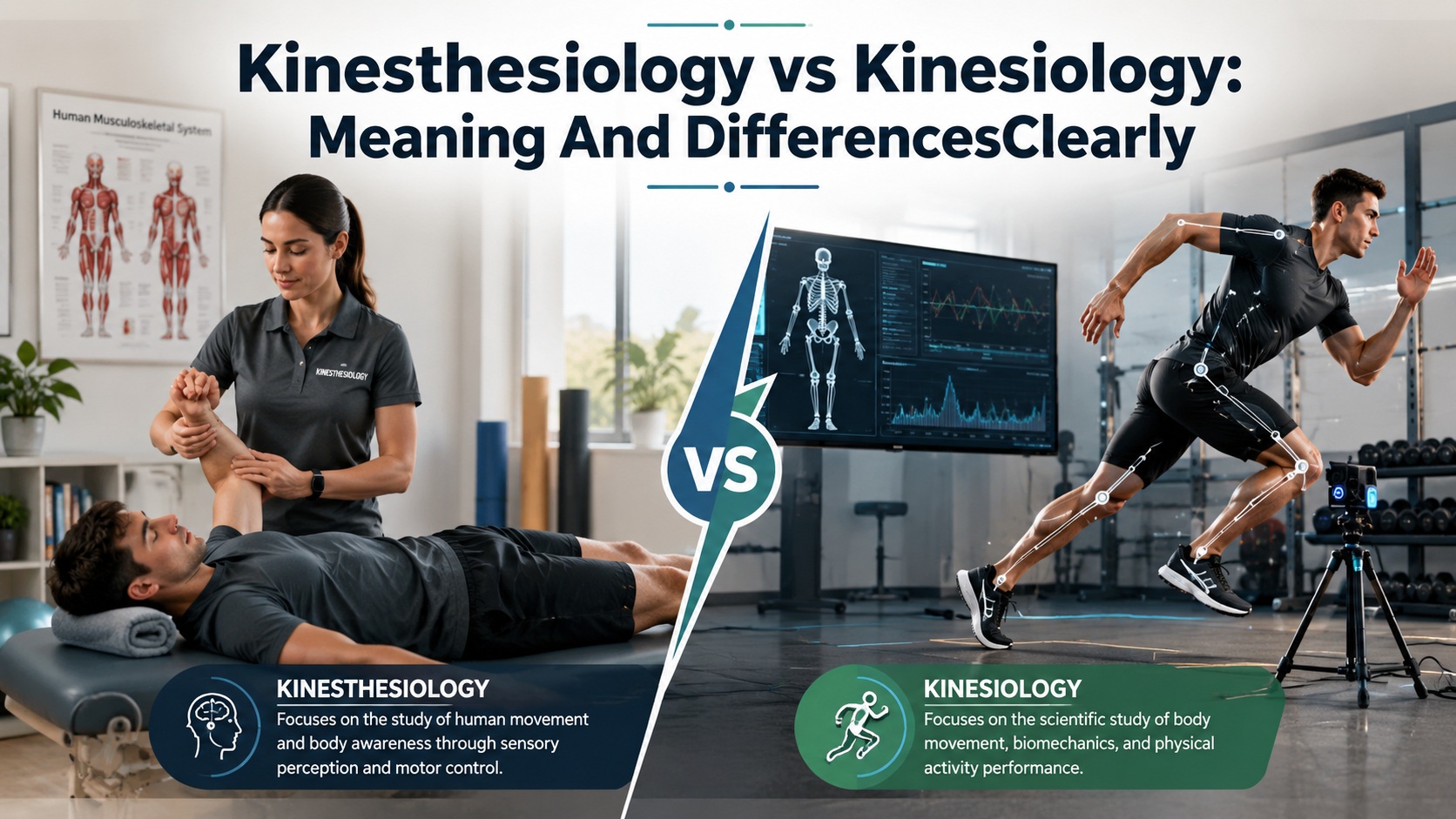
In my academic exposure, I paused and wondered about the confusion between these same sounding words, which look similar yet show a real difference in meaning scope. Many professionals use different ways, and understanding helps improve communication in writing, medical fields, and exercise science, where people often rely on synonyms, subtle differences, and usage.
The kinesthesiology concept connects movement, brain control, and fitness, while it sometimes confuses people globally in kinesiology discussions. I explain clearly for readers in training contexts of exercise science, focusing on body awareness, senses, and a guide idea that helps education today. It also keeps ideas simple, supports learning, and explains language together so research can be chosen correctly in common article studies and writing position.
What Kinesiology Actually Means
Kinesiology is the established scientific study of human movement.
It focuses on how the body moves and why it moves the way it does. The field combines several sciences, including:
- Anatomy (structure of the body)
- Physiology (how the body functions)
- Biomechanics (forces and motion)
- Neuroscience (brain and motor control)
- Psychology (behavior and movement habits)
According to Britannica, kinesiology is “the study of human movement, encompassing physiological, biomechanical, and psychological mechanisms.
Read more: Stich vs Stitch: What’s the Real Difference in Meaning and Usage?
What kinesiology covers in real life
Kinesiology shows up in many practical areas:
- Sports performance and athletic training
- Injury rehabilitation
- Physical therapy support roles
- Ergonomics in workplace design
- Exercise science research
It helps professionals understand how to improve movement efficiency and reduce injury risk.
Simple way to think about it
Think of kinesiology as “the science of how your body moves and performs.”
A coach uses it when improving sprint technique.
A therapist uses it when rebuilding knee strength after injury.
What Kinesthesiology Means (and Why It Causes Confusion)
Now here’s where things get tricky.
Kinesthesiology is not a widely recognized scientific field in modern academic or medical systems.
Most reputable sources explain it as:
- A misused or confused variation of kinesiology
- Or a term loosely linked to kinesthesia (body movement awareness)
Kinesthesia refers to your body’s ability to sense movement and position in space.
What kinesthesiology is often linked to
When people use the term, they usually mean:
- Movement awareness
- Body position sensing
- Coordination and balance perception
But in formal science and education, these ideas are usually covered under:
- Kinesthesia
- Proprioception
- Motor control
Why the confusion happens
The confusion comes from three main sources:
- Similar spelling to kinesiology
- Overlap with movement-related concepts
- Informal or outdated usage in some texts
Some sources even state that kinesthesiology is not a formally recognized academic discipline and is often a misinterpretation of kinesiology.
Simple way to think about it
Think of kinesthesiology as a commonly mistaken label for body awareness concepts, not a standard scientific field.
Kinesthesiology vs Kinesiology: Key Differences at a Glance
Let’s put everything side by side so it becomes crystal clear.
| Feature | Kinesthesiology | Kinesiology |
| Core idea | Body movement awareness | Scientific study of human movement |
| Academic status | Not widely recognized | Established scientific discipline |
| Usage | Rare or informal | Standard in education and healthcare |
| Focus | Sensory perception of movement | Movement mechanics, biology, and performance |
| Professional use | Not commonly used | Used in sports science, rehab, therapy |
How to Use “Kinesiology” Correctly in Writing
If you want accurate, professional writing, kinesiology is the word you should rely on.
Common correct uses
You will see it in contexts like:
- “She studied kinesiology at university.”
- “Kinesiology helps athletes improve performance.”
- “The clinic offers kinesiology-based rehabilitation.”
Where it naturally fits
Kinesiology fits in:
- Academic papers
- Healthcare documentation
- Fitness training programs
- Sports science discussions
Example in context
A physiotherapist used kinesiology principles to design a recovery program for a torn ACL.
This shows how movement science directly supports rehabilitation.
How “Kinesthesiology” Appears in Writing (and Why to Be Careful)
Even though kinesthesiology is not widely accepted, you may still see it online.
Where it appears
- Informal blogs
- Miswritten academic summaries
- SEO articles
- Confused references to kinesthesia
Why it creates problems
Using kinesthesiology incorrectly can:
- Reduce credibility in academic writing
- Confuse readers in professional contexts
- Lead to inaccurate citations
Correcting the mistake
Instead of writing:
- ❌ “Kinesthesiology studies movement mechanics”
You should write:
- ✅ “Kinesiology studies movement mechanics”
- ✅ “Kinesthesia relates to movement awareness”
Common Mistakes Writers Make
Many writers mix these terms without realizing it.
Here are the most frequent errors:
- Treating both words as synonyms
- Using kinesthesiology in academic writing
- Confusing kinesthesia with kinesiology
- Assuming both are medical specialties
Why this matters
Small word errors can change meaning completely in scientific writing. In healthcare and education, precision is not optional.
Context Matters: Choosing the Right Word
Context decides everything.
When to use kinesiology
Use it when talking about:
- Exercise science
- Physical therapy
- Human movement research
- Athletic performance
When kinesthesiology confusion appears
It may show up in:
- Informal discussions
- Older or non-scientific writing
- Misinterpretation of kinesthesia
Real-world example
A sports trainer might say:
“We applied kinesiology principles to improve sprint mechanics.”
But a therapist discussing body awareness might say:
“We focused on proprioception and kinesthetic feedback.”
Notice how different the focus becomes.
Quick Usage Rules to Remember
If you only remember a few things, keep these in mind:
- Use kinesiology for movement science
- Avoid kinesthesiology in formal writing
- Use kinesthesia when discussing body awareness
- Double-check spelling in academic work
A simple rule:
If it sounds scientific and formal, it’s almost always kinesiology.
Practice Section: Test Your Understanding
Try these quick checks.
Fill in the blank
- ________ is the study of human movement science.
Answer: Kinesiology
Choose the correct word
- The study of biomechanics belongs to:
- A) Kinesthesiology
- B) Kinesiology
Answer: B
Fix the sentence
- “Kinesthesiology helps athletes improve movement efficiency.”
Correct version:
- “Kinesiology helps athletes improve movement efficiency.”
Conclusion
Kinesthesiology and Kinesiology may sound alike, but they are not the same thing. One mainly focuses on how the body senses and controls movement, while the other is a broader scientific field that includes biomechanics, anatomy, and physiology. Understanding this difference helps you avoid confusion in academic writing, medical studies, and fitness learning.
When you clearly know when to use each term, your communication becomes more accurate and professional. This is especially important for students, healthcare workers, and anyone working in exercise science or sports-related fields.
FAQs
1. What is the main difference between Kinesthesiology and Kinesiology?
Kinesthesiology focuses on sensory movement control, while Kinesiology is a broader study of human movement, including anatomy and biomechanics.
2. Are Kinesthesiology and Kinesiology the same?
No, they are often confused, but they are not the same. They have different meanings and scopes.
3. Where is Kinesiology used?
Kinesiology is used in sports science, physical therapy, rehabilitation, fitness training, and medical studies.
4. Why do people confuse these terms?
They are confusing because both relate to movement and sound very similar in spelling and pronunciation.
5. Who uses these terms most?
Students, fitness trainers, healthcare professionals, and researchers in exercise science commonly use these terms.