Inflexible Vs Unflexible: What’s The Correct Word To Use? In English, while learning English, even small differences in words can cause confusion, especially when two words like inflexible and unflexible and number 2 appear in learning materials where many people mix up meanings at first glance, and they look like synonyms but their usage and correctness clearly differ.
This article aims to help you understand the meaning and proper context so you can use both words confidently in writing and speaking, even when learners feel confused about whether to use word forms, as I often explore these differences in real lessons to provide clarity across different contexts, and an important note is that both are valid words in the English language, however the more commonly used term is inflexible, which is considered proper word in standard usage.
Inflexible vs Unflexible: Quick Answer First
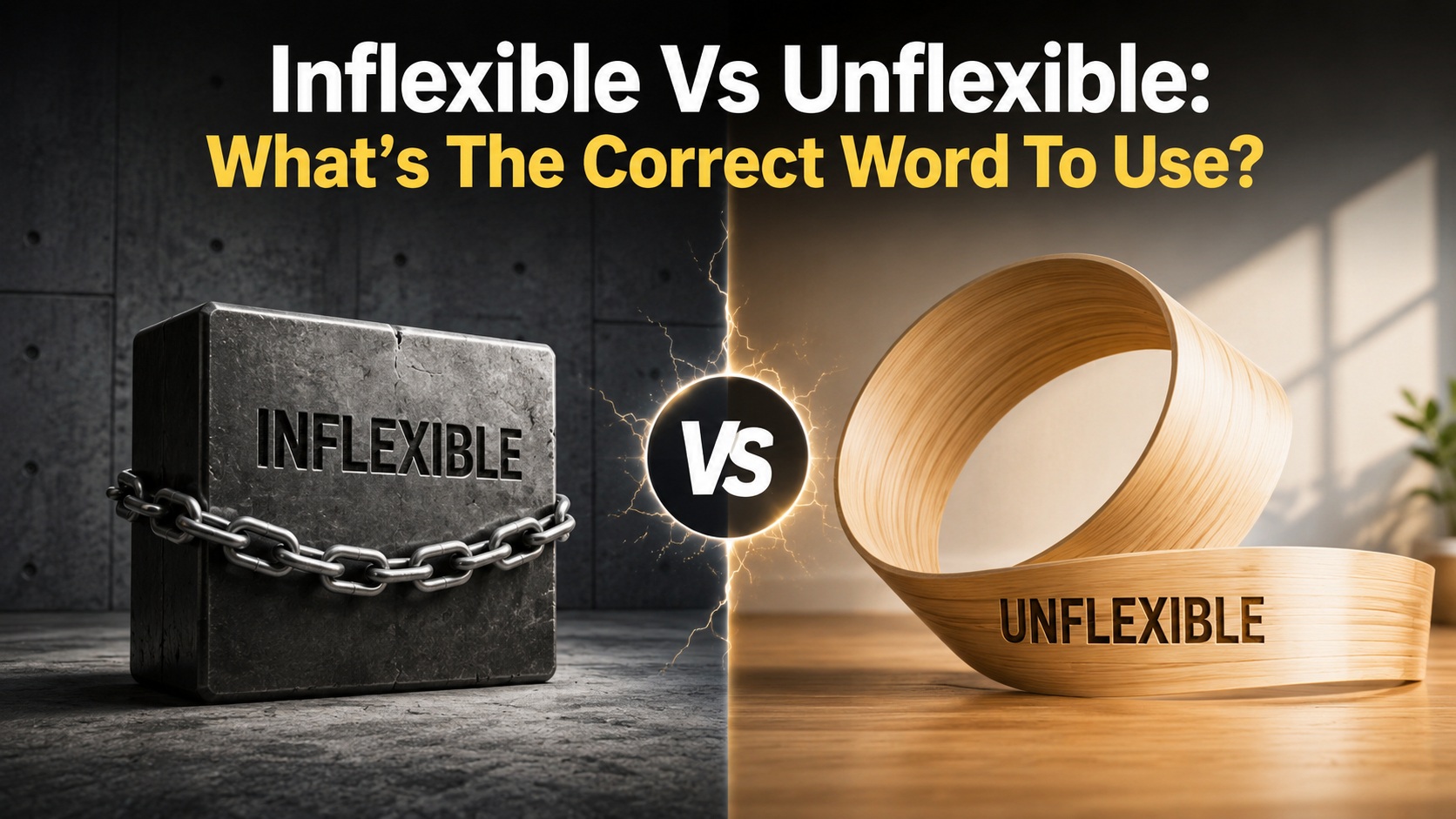
The correct word in standard English is “inflexible.”
“Unflexible” is not considered correct in modern English dictionaries or formal writing.
Here’s the simple truth:
- Inflexible = correct, standard, widely accepted
- Unflexible = incorrect or nonstandard usage
Dictionaries consistently define inflexible as something that cannot bend, change, or adapt easily. It applies to both physical objects and abstract ideas like rules or attitudes.
So if you’re writing anything formal, academic, or professional, stick with inflexible.
Read more: Amber Vs Gold – What’s The Real Difference Between Them?
What “Inflexible” Means in Real Life
The word inflexible carries a strong meaning. It describes something that refuses to change or bend.
In simple terms, it means:
- Not easy to change
- Not open to compromise
- Physically stiff or rigid
Everyday meanings include:
- A strict rule that never changes
- A person who refuses to adjust plans
- A material that does not bend
For example:
- The company has an inflexible policy on refunds.
- He is inflexible when it comes to deadlines.
- The metal rod is too inflexible to shape.
You’ll notice something important here. The word works in both emotional and physical contexts.
What About “Unflexible”? Does It Exist?
This is where things get interesting.
The word “unflexible” is not standard English.
You won’t find it in major dictionaries like Merriam-Webster or Cambridge as a recognized entry. When it does appear, it’s usually labeled as incorrect or nonstandard usage.
So why do people still use it?
It usually happens because:
- The prefix “un-” feels natural in English
- Words like unhappy, unfair, unhealthy are very common
- People assume “un + flexible” should work the same way
But English doesn’t always follow that pattern.
Why “Unflexible” Sounds Wrong in English
English doesn’t use prefixes randomly. It follows historical and linguistic patterns.
Here’s the key idea:
- “Inflexible” comes from Latin-based word formation
- “Un-” is mainly used with Germanic English roots
Since flexible has Latin roots (from flectere, meaning “to bend”), English naturally attaches “in-” instead of “un-”.
That’s why we get:
- Inflexible (correct)
- Invisible (not unvisible)
- Inactive (not unactive in formal usage)
This is why “unflexible” feels off. It breaks the pattern native English developed over centuries.
The Origin of “Inflexible”
The word has a long history.
It comes from Latin:
- in- = not
- flexibilis = able to bend
Put together, it literally means “not able to bend.”
Historical records show the word entered English around the late 14th century.
At first, it described physical objects like stiff materials. Over time, it expanded to describe people, decisions, and systems.
That evolution explains why it still feels powerful in modern writing.
Why People Confuse “Inflexible” and “Unflexible”
This mistake is more common than you might think. It usually comes from three main reasons.
Overgeneralizing “un-”
People naturally use “un-” to form negatives.
Examples:
- happy → unhappy
- fair → unfair
- kind → unkind
So it feels logical to say unflexible. But English isn’t always logical like math.
Speaking before spelling rules
Spoken English doesn’t clearly show prefixes. When you hear “inflexible,” your brain may not separate it into parts.
So when writing fast, people guess.
Influence of informal writing
Social media and texting often relax grammar rules. That’s where nonstandard forms spread quickly.
How to Use “Inflexible” Correctly in Sentences
Now let’s make this practical.
You can use inflexible in three main ways.
People
- She is inflexible when it comes to rules.
Systems or rules
- The school has an inflexible attendance policy.
Physical objects
- This plastic is too inflexible for packaging.
Quick tip:
If you can replace it with “rigid” or “strict,” then “inflexible” fits perfectly.
Why You Should Avoid “Unflexible” in Writing
Even if people understand what you mean, it creates problems.
Here’s why it’s risky:
- It looks like a spelling mistake
- It reduces credibility in formal writing
- It may confuse readers or editors
- It is flagged in most grammar tools
Think of it like showing up to a formal meeting with casual clothes. People still understand you, but it sends the wrong signal.
Synonyms for “Inflexible” Based on Context
Instead of repeating the same word, you can switch depending on meaning.
For rules and systems
- strict
- rigid
- unyielding
For personality or behavior
- stubborn
- uncompromising
- hard-headed
For physical objects
- stiff
- rigid
- unbending
Better Alternatives If You Meant “Unflexible”
Sometimes people use “unflexible” because they struggle to find the right word.
Here’s a quick guide:
| What you mean | Better word |
| Cannot bend physically | rigid, stiff |
| Does not change opinion | stubborn, inflexible |
| Rules are strict | strict, rigid |
| Cannot adapt | unyielding |
This helps you sound more natural and precise.
Side-by-Side Comparison: Inflexible vs Incorrect Usage
| Feature | Inflexible | Unflexible |
| Dictionary recognition | Yes | No (nonstandard) |
| Formal writing use | Correct | Incorrect |
| Meaning clarity | High | Confusing |
| Academic acceptance | Accepted | Rejected |
| Reader perception | Professional | Error-like |
The difference is not small. It directly affects how your writing is judged.
Example Sentences Using “Inflexible”
Let’s see how it works in real writing.
- The manager’s inflexible attitude slowed down the project.
- Some materials are so inflexible that they crack under pressure.
- His inflexible approach made teamwork difficult.
- The government followed an inflexible set of regulations.
Notice how the tone changes depending on context. That’s the strength of the word.
Common Questions About Inflexible vs Unflexible
Is “unflexible” ever correct?
No. It is not accepted in standard English.
What is the opposite of flexible?
Common opposites include:
- inflexible
- rigid
- stiff
- unyielding
Why do people say “unflexible”?
Because “un-” feels like a natural negative prefix in English.
Can I use “unflexible” in creative writing?
You can, but it may still look like an error unless used intentionally for stylistic effect.
Conclusion
In everyday English, confusion between inflexible and unflexible is common, especially while learning English. Both may seem similar at first glance, but usage and correctness clearly differ. In most real-life contexts, inflexible is the more commonly used term and is considered the proper word, while unflexible is less common but still understood. Understanding these small differences helps improve writing and speaking clarity.
FAQs
1. Is “inflexible” correct English?
Yes, inflexible is correct and widely used in the English language.
2. Is “unflexible” a real word?
Yes, unflexible exists, but it is not commonly used in modern usage.
3. What is the difference between them?
Inflexible means unable to change or adapt, while unflexible simply means not flexible.
4. Which word should I use in writing?
You should use inflexible because it is the proper word in most contexts.
5. Why do people get confused between them?
Because both words look similar and are treated as synonyms at first glance, causing confusion during learning English.