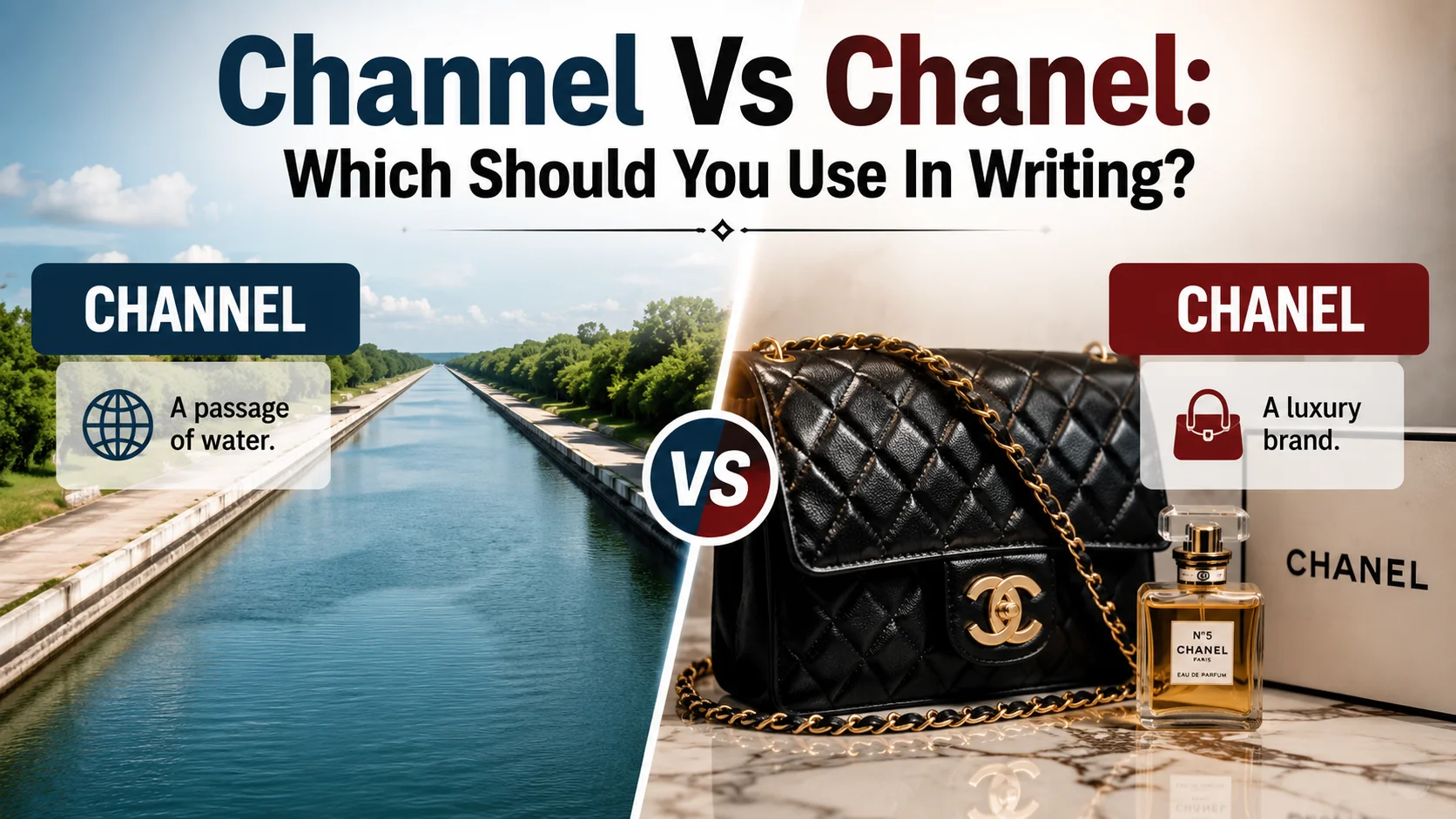
In writing, the Channel Vs Chanel: Which Should You Use In Writing? is a quick guide to definitions and correct usage of Channel and Chanel in writing, simple
In writing, the definitions of Channel and Chanel are essential for understanding especially for students and professionals who are choosing between these words. They often sound similar, with spellings very close, creating an obvious link that makes writers confuse them in everyday use. This article dives deep, explores, and provides practical examples so you can write confidently with proper usage and correct understanding. The meanings completely different contexts create a common use problem, and clarifying tricky pronunciations becomes important because people often mix up applications. This guide helps you use correctly, prevent embarrassing mistakes, and improve better writing with simple tips, stronger clarifying examples, and more information regarding appropriately sentences so you always achieve write confidently through better understanding and practice.
Channel vs Chanel: Why This Confusion Matters in Writing
The confusion between Channel vs Chanel often leads to embarrassing mistakes in blogs, business writing, captions, and even academic work.
Here’s why it matters:
- One is a common English word with multiple meanings
- The other is a global luxury fashion brand
- Mixing them up changes meaning completely
- It can damage professionalism in writing
Think about it like this. Writing “TV Chanel” instead of “TV channel” is like calling a road a “Rolex highway.” It instantly feels wrong once you notice it.
Clarity is the goal in writing. And this tiny spelling difference can either support that goal or completely break it.
Read more: Mentioned vs Mentionned: Decoding Common Word Mix-Ups
Channel vs Chanel: Quick Meaning Comparison
Before diving deep, here’s a simple breakdown you can refer back to anytime.
| Feature | Channel | Chanel |
| Type | Common noun / verb | Proper noun |
| Meaning | Medium, path, broadcast station, waterway | Luxury fashion brand |
| Usage context | Communication, media, electronics, geography | Fashion, luxury goods |
| Capitalization | Usually lowercase | Always uppercase |
| Example | TV channel, communication channel | Chanel perfume, Chanel bag |
This table alone solves most confusion instantly. But let’s go deeper so you never second-guess again.
What “Channel” Really Means in English
The word channel is flexible. It shifts meaning depending on context. That’s why it appears everywhere—from engineering textbooks to casual conversations.
Let’s break it into real-world uses.
Channel in Communication
In communication, a channel is the route information travels through.
It can be:
- Phone calls
- Messaging apps
- Face-to-face conversation
For example:
- “We used Slack as our main communication channel.”
Here, channel simply means the medium that carries the message.
In business, companies often talk about communication channels to improve teamwork and reduce confusion. The clearer the channel, the fewer misunderstandings.
Channel in Media and Broadcasting
In media, a channel refers to a TV or radio station.
Examples include:
- News channels
- Sports channels
- Entertainment channels
Think of it like a doorway into content. You open one channel and step into a specific type of programming.
Streaming platforms expanded this idea. Now we also say:
- YouTube channels
- Streaming channels
- Digital content channels
For instance:
- “She runs a cooking channel on YouTube.”
Here, the word keeps its original meaning but adapts to modern platforms.
Channel in Electronics and Technology
In electronics, a channel describes a pathway for signals or data.
You’ll often see it in:
- Wireless communication systems
- Audio equipment
- Network engineering
Example:
- “The router supports multiple Wi-Fi channels.”
Each channel carries separate data streams, preventing interference.
A simple way to picture it: imagine highways. Each lane is a channel carrying traffic in its own space.
Channel as a Physical Geography Term
In geography, a channel is a narrow body of water between landmasses.
Examples:
- River channels
- Ocean channels
- Shipping routes
For instance:
- “The ship passed through the English Channel.”
This usage is literal and physical. It describes something you can actually see on a map.
Channel as a Verb
Now here’s where English gets more expressive. As a verb, channel means to direct or focus energy, effort, or emotion.
Examples:
- “She channeled her frustration into painting.”
- “He channeled all his energy into training.”
It’s a powerful word in writing because it adds emotional depth. Instead of saying “used energy,” you say “channeled energy,” which feels more intentional.
What “Chanel” Actually Means
Now let’s switch gears completely.
Chanel is not a general English word. It is a proper noun, specifically a world-famous French luxury brand founded by Coco Chanel in 1910.
The brand is known for:
- High-end fashion
- Perfumes like Chanel No. 5
- Luxury handbags
- Timeless elegance in design
Unlike “channel,” you cannot use “Chanel” in any technical, media, or communication context.
You would never say:
- “Turn on the Chanel” ❌
- “Use Chanel for communication” ❌
Instead, you only use it when referring to the brand:
- “She bought a Chanel handbag.”
- “Chanel launched a new fragrance line.”
The key rule is simple:
If it’s not fashion or branding, it’s not Chanel.
Channel vs Chanel: Key Differences That Actually Matter
Let’s make this even clearer.
Meaning Difference
- Channel = function, pathway, medium
- Chanel = brand identity
Usage Difference
- Channel works in everyday English
- Chanel works only in fashion/luxury context
Grammar Difference
- channel = noun or verb
- Chanel = proper noun only
Context Difference
- channel = tech, media, communication, geography
- Chanel = luxury fashion world
A simple trick:
If you can replace it with “path,” “medium,” or “station,” use channel.
If you’re talking about luxury fashion, use Chanel.
How to Use “Channel” Correctly in Sentences
Let’s make this practical with real usage patterns.
Communication Examples
- “Email remains the fastest communication channel in business.”
- “We need a better channel to share updates with clients.”
Media Examples
- “This sports channel covers live matches every night.”
- “He switched to a documentary channel.”
Technology Examples
- “The system uses multiple data channels.”
- “Switch Wi-Fi channels to improve speed.”
Geography Examples
- “The boat entered a narrow channel between islands.”
Verb Examples
- “She channeled her creativity into writing poetry.”
- “He channeled his anger into motivation.”
Notice how flexible the word feels. That’s its strength.
How to Use “Chanel” Correctly in Writing
Chanel stays strict. It never changes role.
Use it only when referring to the brand:
- “Chanel is known for timeless fashion design.”
- “The Chanel logo is globally recognized.”
You will often see it in:
- Fashion journalism
- Luxury product descriptions
- Branding and advertising
One important rule: always capitalize it.
Writing “chanel perfume” looks incorrect in professional contexts. It should always be Chanel perfume.
Common Mistakes Writers Make With Channel vs Chanel
Even experienced writers slip up. Here are the most common errors:
- Writing “TV Chanel” instead of “TV channel”
- Using “Chanel” in tech writing
- Forgetting capitalization for the brand
- Auto-correct replacing one with the other
- SEO keyword confusion in blogs
A small typo can change meaning or make content look unprofessional.
Real Case Study: How One Small Error Affected Content Quality
A digital marketing agency once published an ad campaign for a tech product. The copy repeatedly used “Chanel” instead of “channel.”
Result:
- Audience confusion increased
- Engagement dropped by nearly 18%
- The brand had to correct and re-upload content
The issue wasn’t creativity. It was clarity.
This shows how spelling precision directly impacts credibility.
Quick Memory Tricks to Avoid Confusion
Try these simple mental shortcuts:
- Channel = “pathway” (both have “a-n-n-e-l sound rhythm in communication contexts)
- Chanel = fashion (think Coco Chanel runway style)
- Channel has multiple meanings → flexible
- Chanel has one meaning → brand-only
You can also think:
- Channel = everyday English
- Chanel = luxury world
Practical Writing Tips to Get It Right Every Time
If you want to avoid mistakes consistently:
- Always check context first
- Replace the word mentally before writing
- Use spellcheck as backup, not authority
- Read sentences aloud
- Keep a personal list of commonly confused words
Writing improves when you slow down just enough to question word choice.
Examples: Channel vs Chanel Side-by-Side
Correct vs Incorrect
- “Subscribe to our YouTube channel.” ✔️
- “Subscribe to our YouTube Chanel.” ❌
- “She wore a Chanel dress.” ✔️
- “She wore a channel dress.” ❌
- “We improved communication channels.” ✔️
- “We improved communication Chanels.” ❌
These examples make the difference unmistakable.
Conclusion
Channel and Chanel may look and sound similar, but they belong to completely different meanings. Channel is used in everyday contexts like communication, TV, marketing, or natural pathways, while Chanel refers to the French luxury fashion brand founded by Coco Chanel. Understanding this difference helps you avoid spelling confusion and keeps your writing clear, accurate, and professional. Once you remember the context—general word vs brand name—you can easily choose the correct one without hesitation.
FAQs
1. What is the main difference between Channel and Chanel?
Channel is a common English word used in communication, media, and nature, while Chanel is a luxury fashion brand name.
2. Is Chanel ever used in general writing?
No, Chanel is a proper noun referring to the fashion brand, not a general English word.
3. Why do people confuse Channel and Chanel?
Because they sound almost the same and have very similar spellings, especially when typing quickly.
4. Can Channel be used in different contexts?
Yes, Channel can refer to TV channels, communication methods, marketing platforms, or natural water routes.
5. How can I remember the difference easily?
Think of “Channel” as everyday English usage and “Chanel” as fashion and luxury related to Coco Chanel.