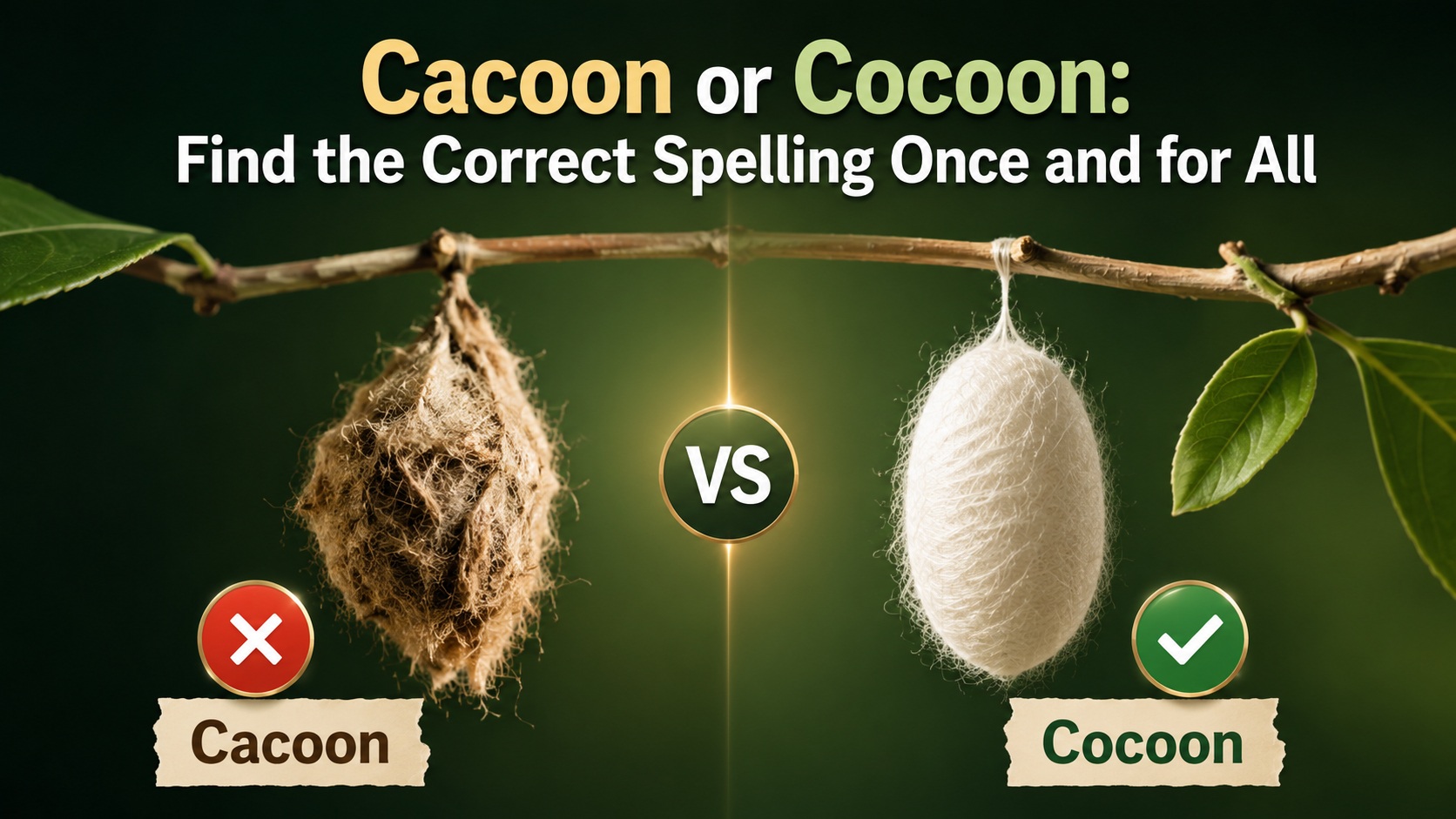
Many English learners and even native speakers get confused about Spelling of cacoon and cocoon because these words look and sound almost the same in English pronunciation. This confusion happens when people hear similar sounds and write the word incorrectly, which is a very common mistake, especially with tricky words.
There is a simple way to remember the correct spelling. Cocoon is the correct form used for the silky case made by butterflies and moths during transformation. It also carries metaphorical meanings like safety, growth, and change. The structure is protective, formed through a natural process, and is not an error when spelled correctly.
On the other hand, cacoon is rare and refers mainly to a tropical plant used in traditional medicine. Understanding this difference is important for writing correctly and also for learning about nature, insects, and plants. By the end, you will not mix them up again, and your understanding of cacoon or cocoon in real English use becomes much clearer.
Why People Confuse Cocoon and Cacoon So Easily
You might think this is just a typing mistake. But there’s more going on here.
The confusion usually comes from a mix of real-world language habits:
Read more: Developed vs Developped: Which Should You Use In Writing?
Pronunciation traps
When people say “cocoon” quickly, the middle sound can blur. It often sounds like “ca-koon” or “cu-koon,” which leads to spelling errors.
Keyboard and typing errors
On QWERTY keyboards, the letters “a” and “o” are close enough that fast typing creates mistakes.
Autocorrect interference
Some devices “guess” wrong spellings based on weak context, especially if the word is typed incorrectly before.
Similarity to familiar words
English has many double-vowel words:
- balloon
- cartoon
- raccoon
So the brain sometimes assumes a pattern and incorrectly forms “cacoon.”
Search behavior reality
Search engines regularly show data where people type:
- “cacoon meaning”
- “cacoon insect”
- “what is a cacoon”
But nearly all of these searches actually intend cocoon.
Cocoon: The Correct Spelling and Its Core Meaning
The word cocoon has two major meanings in English.
Biological meaning
A cocoon is a protective casing created by certain insects during metamorphosis.
Metaphorical meaning
It describes a state of isolation, protection, or transformation.
Both meanings are widely used, but the biological one is the original root.
Cocoon in Biology: The Real Science Behind It
In biology, a cocoon is not just a “shell.” It is a survival system.
A true cocoon is produced by insects such as moth larvae before they transform into adults.
One of the most studied species is the silkworm:
Bombyx mori
This insect creates a cocoon made of silk protein.
What is inside a cocoon?
Inside, the insect is going through metamorphosis, a biological transformation from larva to adult.
Key stages of transformation
The life cycle usually follows this path:
- Egg
- Larva (caterpillar stage)
- Cocoon formation
- Pupa stage inside cocoon
- Adult emergence
This process is not random. It is genetically programmed and tightly controlled by hormones like ecdysone.
How a Cocoon Is Formed Step by Step
The formation process is surprisingly precise.
Step 1: Feeding phase
The larva eats continuously to store energy.
Step 2: Silk gland activation
Special glands begin producing liquid silk proteins.
Step 3: Spinning begins
The insect moves its head in a figure-eight pattern, laying silk thread.
Step 4: Protective enclosure
It wraps itself fully, forming a dense shell.
Step 5: Hardening
The silk solidifies when exposed to air.
A single cocoon can contain:
- Hundreds of meters of silk fiber
- Extremely compact structural layering
Scientific Facts About Cocoons You Probably Didn’t Know
Let’s look at real biological data.
Silk length per cocoon
A single silkworm cocoon can produce:
- 300 to 900 meters of silk filament
That’s nearly the length of 3 to 9 football fields.
Usable silk yield
Not all silk is usable. After processing:
- Only 30% to 40% becomes commercial silk thread
Cocoon weight
- Average cocoon weight: 0.3 to 0.5 grams
Temperature protection
Cocoons naturally regulate internal conditions to protect the pupa from:
- heat
- cold
- humidity changes
- predators
Cocoon vs Chrysalis: A Common Confusion
People often mix these up.
| Feature | Cocoon | Chrysalis |
| Made of silk | Yes | No |
| Created by | Moth larvae | Butterfly pupae |
| Structure type | External casing | Hardened body form |
| Material | Silk protein | Exoskeleton |
A cocoon is built. A chrysalis is transformed.
Cocoon in Metaphorical Language
Outside biology, “cocoon” has become a powerful metaphor.
Emotional meaning
When someone says:
“I just want to cocoon myself for a while”
They usually mean:
- withdrawal from stress
- emotional protection
- need for comfort and isolation
Modern lifestyle use
The idea of “cocooning” became popular in wellness culture:
- staying indoors
- reducing social pressure
- creating safe personal spaces
Work culture analogy
In business, a “cocoon phase” often means:
- early-stage development
- private testing period
- slow growth before public launch
Think of it like a startup incubating before it flies.
Cocoon in Technology and Design
Designers often borrow from nature.
Architecture
Buildings inspired by cocoons often focus on:
- curved protective structures
- enclosed private spaces
- soft lighting environments
Product design
You’ll see cocoon-like ideas in:
- ergonomic chairs
- pod sleeping systems
- noise-canceling environments
Software metaphor
Developers sometimes call secure environments:
- “sandbox cocoon systems”
meaning isolated environments where code runs safely.
Is “Cacoon” a Real Word?
Let’s be direct.
Standard English
“Cacoon” is not recognized in major dictionaries as a valid word.
It is considered:
- a spelling mistake
- a phonetic error
- a variant used in informal typing
Where it appears anyway
You’ll still see “cacoon” in:
- social media posts
- blog typos
- product branding attempts
- keyword search errors
But none of these make it linguistically correct.
Can “Cacoon” Ever Be Correct?
Technically, yes—but only in one situation:
👉 If it is used as a brand name or proper noun
For example, companies sometimes intentionally misspell words to:
- create uniqueness
- secure domain names
- stand out in branding
But in grammar, education, and science:
👉 It remains incorrect.
Cocoon vs Cacoon Comparison Table
Here’s a clear breakdown:
| Category | Cocoon | Cacoon |
| Standard spelling | Yes | No |
| Dictionary entry | Yes | No |
| Biological term | Yes | No |
| Scientific usage | Valid | Incorrect |
| Search accuracy | High | Low |
| SEO value | Strong | Weak (error-based) |
| Branding use | Rare but valid | Sometimes used |
Why Correct Spelling Actually Matters
This is where many people underestimate the issue.
1. Academic accuracy
Using the wrong spelling can lower credibility in:
- essays
- research papers
- scientific writing
2. SEO and search ranking
Search engines prioritize correct spelling.
If you use “cacoon,” you may:
- miss traffic
- confuse algorithms
- reduce visibility
3. Professional communication
Imagine sending a biology report with the wrong term. It instantly weakens trust.
4. Knowledge clarity
Correct spelling ensures:
- better learning
- fewer misunderstandings
- cleaner communication
Fascinating Facts About Cocoons in Nature
Nature is far more creative than we think.
Silk strength
Silk fiber is incredibly strong for its weight.
It is often compared to steel in tensile strength per gram.
Water resistance
Some cocoons naturally repel water to protect the pupa.
Multi-layer protection
Many species build:
- outer loose layers
- inner dense layers
Camouflage ability
Some cocoons blend into:
- tree bark
- soil
- leaves
Evolutionary Importance of Cocoons
Cocoons didn’t evolve randomly. They provide survival advantages.
Key benefits
- Protection from predators
- Shield from environmental stress
- Safe metamorphosis environment
- Energy conservation during transformation
Without cocoons, many moth species would not survive to adulthood.
Case Study: The Silk Industry and Cocoons
The silk industry is one of the oldest biological industries in human history.
It is built almost entirely around silkworm cocoons.
Bombyx mori plays the central role.
How silk is produced
- Silkworms are raised in controlled environments
- They spin cocoons
- Cocoons are collected before emergence
- Silk threads are unwound carefully
- Threads are woven into fabric
Global production reality
- China produces roughly 70% of the world’s raw silk
- India follows as a major producer
- Silk remains a multi-billion-dollar textile industry
Ethical innovation
Modern industries also explore:
- peace silk (harvested without killing larvae)
- synthetic silk alternatives
- sustainable farming methods
How to Remember the Correct Spelling “Cocoon”
Here are simple memory tricks that actually work:
Method 1: Double “O” meaning double protection
Think:
cocoon = double O = double layer of protection
Method 2: Visual association
Picture a caterpillar wrapped in a soft “OO” shaped shell.
Method 3: Word breakdown
CO + COON
Say it slowly: “co-coon”
Method 4: Compare with balloon
Both end in “-oon” not “-oon with a twist”
Why “Cacoon” Still Shows Up in Search Engines
Even though it’s incorrect, it appears a lot online.
Main reasons
- Typing mistakes
- Voice-to-text errors
- Low spelling familiarity
- Repeated incorrect usage online
Search engines are smart enough to:
- correct it automatically
- suggest “Did you mean cocoon?”
But content creators still sometimes target it for traffic.
SEO Insight: Handling Misspellings Strategically
Smart content doesn’t ignore mistakes. It uses them wisely.
A strong SEO strategy:
- targets “cocoon” as the primary keyword
- includes “cacoon” as a secondary misspelling
- educates users instead of misleading them
This helps:
- capture traffic
- improve clarity
- reduce confusion
Conclusion
The confusion between cacoon and cocoon is very common in English, especially because both words sound similar. However, the correct spelling for the insect’s protective stage is cocoon, which is widely used in science, education, and everyday writing. On the other hand, cacoon is rarely used and refers to a tropical plant, not insects.
Understanding this small difference helps improve your writing accuracy, avoids mistakes in academic or professional content, and builds confidence in English usage. Once you remember this rule, you will no longer mix the two words again.
FAQs
1. What is the correct spelling: cacoon or cocoon?
The correct spelling is cocoon when referring to the protective case made by insects like butterflies and moths.
2. Is “cacoon” a real English word?
Yes, cacoon exists, but it is rare and usually refers to a tropical plant used in traditional medicine, not insects.
3. Why do people confuse cacoon and cocoon?
They are confused because both words sound almost the same in pronunciation, which leads to spelling mistakes.
4. What does “cocoon” mean?
A cocoon is a silky protective covering made by insects during their transformation process into adults.
5. How can I easily remember the correct spelling?
Think of butterflies and moths—these insects create a cocoon, not a “cacoon.” This simple association helps you remember the correct form.