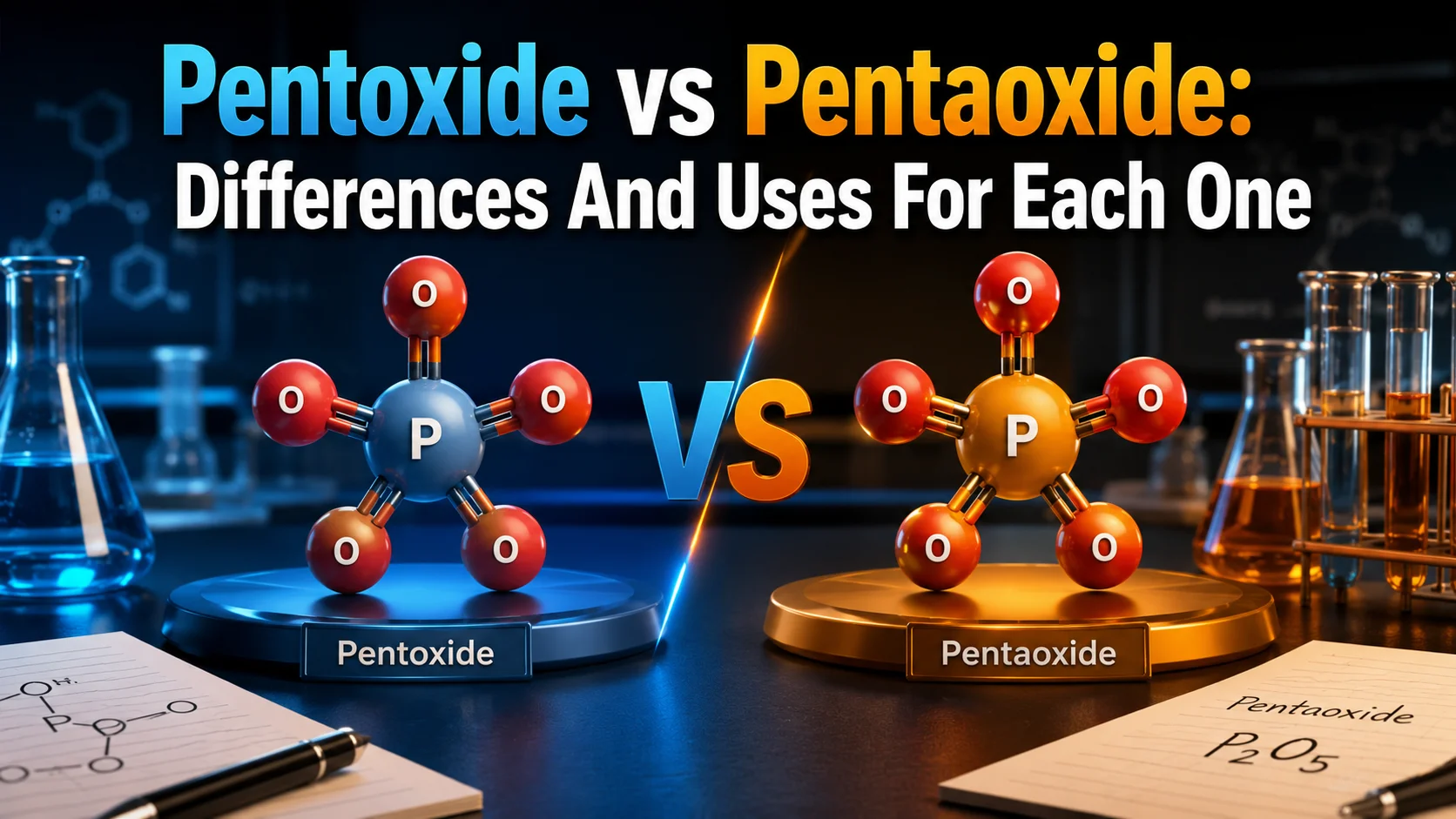
Pentoxide vs Pentaoxide: Differences And Uses For Each One explains how one small spelling change in chemistry can affect meaning and clarity. Although both words look the same, scientific writing, modern scientific writing, and chemical naming rely on the correct term. The prefix penta with oxide describes a chemical compound that contains five oxygen atoms and one other element, making scientific terminology, nomenclature, and proper understanding important for readers, students, scientists, and writers who read textbooks and research papers.
In daily language, these words are sometimes used interchangeably, which can leave a confused reader unsure about the proper word. From experience, checking the context, the chemical formula, and the accepted usage is the easiest way to avoid mistakes. One form may appear more often because experts prefer the standard word, while the other may rarely appear in formal work. Knowing the difference, key differences, and correct usage helps you avoid errors in grammar, writing, and technical documents so you can write more clearly and confidently.
In this article, the main point is explained step by step so you can look at both sides before choosing the correct name. A clear explanation should describe chemical compounds, refer to the right compounds, and help you know the correct and correct ways to use each term. Whether you study from textbooks or research papers, learning the role of oxygen atoms, the element, and proper usage builds knowledge and supports the practical uses of these chemistry terms
Pentoxide vs Pentaoxide: quick comparison
Here is the practical difference in one glance.
| Term | Modern usage | What it usually means | Best place you will see it |
| Pentoxide | Preferred and far more common | An oxide with five oxygen atoms in the name or formula unit | Textbooks, journals, dictionaries, databases |
| Pentaoxide | Less common and often database-style or historical | The same chemical idea in a few established names | Regulatory entries, older sources, some common names |
This comparison follows current dictionary usage and IUPAC-style stoichiometric naming patterns. The key point is that pentoxide is the safer choice for modern general writing while pentaoxide shows up in some established names such as diphosphorus pentaoxide in ECHA and NIST records.
Read more: Cheer Vs Chear: When To Use Each One? What To Consider
What does pentoxide mean?
At its core, pentoxide means an oxide associated with five oxygen atoms. In English chemical naming, the prefix penta- signals five and oxide tells you the compound contains oxygen. In many modern names the vowel at the end of the prefix gets smoothed away when it meets another vowel sound. That is why chemistry often prefers names like pentoxide instead of the more awkward-sounding pentaoxide. IUPAC’s inorganic nomenclature examples show this same contraction pattern in names such as carbon monooxide and chromium mon(o)oxide.
The important thing to remember is that “pentoxide” does not always mean a single isolated molecule made of five oxygen atoms glued to something else in the simplest way possible. In real chemistry it often names a compound family or a stoichiometric oxide unit. That is why phosphorus pentoxide can be described as a polymeric solid that is commonly connected to the empirical formula P2O5 even though the familiar molecular form is P4O10. The label is useful because it tells you the oxygen ratio and the oxidation pattern without forcing you into a misleading one-molecule picture.
What does pentaoxide mean?
Pentaoxide is basically a spelling variant you may run into in certain database entries, historical naming styles, or established compound names. It is not the form that modern chemistry writers usually reach for first. In other words, the idea is the same but the spelling sits outside the most common contemporary convention. You can see this in official and semi-official records where diphosphorus pentaoxide appears as a name for the compound with formula P2O5 / P4O10.
That said, pentaoxide is not the form readers expect in standard modern prose. Dictionaries and chemistry references overwhelmingly favor pentoxide in their headwords and examples. Merriam-Webster lists pentoxide, phosphorus pentoxide, vanadium pentoxide, niobium pentoxide, and iodine pentoxide as active entries. That tells you where current usage sits.
Why is it pentoxide instead of pentaoxide?
This is where naming convention matters. IUPAC inorganic nomenclature uses systematic rules to keep names readable and consistent. In its examples for binary and stoichiometric compounds the Red Book shows forms like mon(o)oxide and dinitrogen oxide rather than awkward doubled vowels. It also lists compounds such as chromium mon(o)oxide, chromium dioxide, chromium trioxide, manganese dioxide, manganese trioxide, and manganese heptaoxide. That pattern makes the logic behind pentoxide easy to see.
The rule is mainly about euphony and clarity. Chemists want a name that reads smoothly and avoids clunky vowel collisions. So instead of spelling out every vowel from every prefix in a literal way, the name often compresses into a cleaner form. That is why monooxide becomes monoxide in common English chemistry usage and why pentaoxide is usually reduced to pentoxide. You can think of it like trimming a loose thread before it snags the whole sweater.
Pentoxide vs Pentaoxide in real chemistry writing
In real-world chemistry writing, pentoxide is the form that appears in dictionaries, textbooks, and reference entries. Merriam-Webster’s entries for phosphorus pentoxide, vanadium pentoxide, niobium pentoxide, iodine pentoxide, and tantalum pentoxide all use the contracted spelling. That is a strong signal of mainstream English scientific usage.
By contrast, pentaoxide tends to appear in a narrower set of contexts. ECHA’s entry for diphosphorus pentaoxide and NIST’s WebBook entry for the same substance show how the longer form can survive in database-style naming. So the spelling is not imaginary. It is just much less common in polished modern prose.
Compounds that use pentoxide
Some of the best-known examples are worth keeping in your mental toolbox.
| Compound name | Formula | Common use or note |
| Phosphorus pentoxide | P4O10 or commonly connected to P2O5 | Powerful drying and condensing agent; phosphorus acid anhydride |
| Vanadium pentoxide | V2O5 | Used in glass manufacture and as a catalyst |
| Niobium pentoxide | Nb2O5 | White infusible powder; important in materials chemistry |
| Iodine pentoxide | I2O5 | Oxidizes carbon monoxide quantitatively to carbon dioxide |
| Tantalum pentoxide | Ta2O5 | Used in optical glass and in making tantalum carbide |
| Nitrogen pentoxide | N2O5 | Unstable crystalline oxide and a useful reagent in nitric acid chemistry |
These examples are all documented in current dictionary entries or authoritative database records. They show that pentoxide is not a single special case. It is a productive naming pattern used across several elements.
What phosphorus pentoxide teaches you
Phosphorus pentoxide is the classic example because it shows why chemical names are often more practical than literal. Merriam-Webster describes it as a compound found in various polymeric forms and says it is obtained by burning phosphorus in excess dry air. It is also described as a white powder that reacts vigorously and sometimes explosively with water and is used chiefly as a drying agent and condensing agent in organic synthesis.
That matters because students often assume the name must describe one tiny isolated molecule. In this case, it does not. The familiar substance is better treated as a family of related oxide forms. The name “phosphorus pentoxide” survives because chemists need a quick shorthand for the oxygen-rich phosphorus oxide system. In everyday chemistry work that shorthand is more useful than writing out a structural explanation every time.
What vanadium pentoxide teaches you
Vanadium pentoxide is another good example because it shows how the name connects directly to use. Merriam-Webster defines it as a yellowish-red crystalline compound V2O5 used especially in glass manufacture and as a catalyst. That alone tells you why the compound matters outside the classroom. It is not just a formula on paper. It is an industrial material with real job-site value.
This is a nice reminder that chemical names are not only about spelling rules. They also point to practical roles. When a chemist sees vanadium pentoxide, they know they are dealing with a specific oxide with a well-known oxidation state and a strong industrial footprint. The name is short enough to use in a production note and specific enough to be useful.
What niobium and tantalum pentoxide teach you
Niobium and tantalum add another layer because they show the same naming pattern in advanced materials chemistry. Merriam-Webster describes niobium pentoxide as a compound Nb2O5 obtained as a white infusible powder. It also describes tantalum pentoxide as a crystalline pentoxide Ta2O5 used in making optical glass and tantalum carbide. Those are not niche trivia facts. They are the real reasons the compounds show up in industrial and research settings.
This also helps explain why the pentoxide naming pattern remains alive. It is convenient. It works across many element families. And it tells experienced readers what kind of oxide chemistry they are likely dealing with before they even look at the full structure or formula. That is efficiency with a lab coat on.
What iodine and nitrogen pentoxide teach you
Iodine pentoxide is a good reminder that not all pentoxides are used the same way. Merriam-Webster defines it as a white crystalline solid I2O5 used to oxidize carbon monoxide quantitatively to carbon dioxide. That makes it especially valuable in analytical and preparative chemistry where precision matters.
Nitrogen pentoxide is another important example. Merriam-Webster describes it as a white crystalline unstable compound N2O5 that can be made by oxidizing nitrogen dioxide with ozone or by dehydrating nitric acid. It also notes that it yields nitric acid on combination with water with much heat. That makes the compound a useful but reactive member of the nitrogen oxide family.
These examples show why pentoxide is more than a spelling preference. It is a naming pattern attached to compounds with very different behaviors. Some are industrial catalysts. Some are dehydrating agents. Some are analytical reagents. The common thread is the oxide naming logic.
Pentoxide vs Pentaoxide: which one should you use?
Use pentoxide in almost all modern writing. That includes academic work, science blogs, study notes, technical reports, and SEO content. It matches current dictionary entries and the spelling pattern that readers expect. IUPAC’s examples also support the broader contraction style used in inorganic names.
Use pentaoxide only when you are reproducing a source that already uses it or when a specific database or regulatory entry uses that exact wording. That is the safest rule. It keeps your writing aligned with modern usage without distorting a historical or official name. ECHA and NIST show that some compound records still preserve the longer form in established names like diphosphorus pentaoxide.
Common mistakes people make with pentoxide
One common mistake is treating pentaoxide as if it were the everyday standard. It is not. Modern chemistry readers are much more likely to expect pentoxide. That matters because awkward or nonstandard wording can make an article look shaky even when the chemistry itself is correct.
Another mistake is assuming every pentoxide is a simple molecule with five oxygen atoms arranged in one neat unit. That idea breaks down quickly. Phosphorus pentoxide is the clearest counterexample because the familiar solid exists in polymeric forms and the common name is tied to the empirical formula rather than a single small molecule.
A third mistake is mixing up common names and formal systematic names. For example, IUPAC-style naming may produce names that look different from the familiar classroom name. That is normal. Chemistry often has more than one valid naming lens and each one serves a different purpose.
A simple case study: choosing the right name in a lab report
Imagine you are writing a lab report on the dehydration of phosphorus compounds. If you say phosphorus pentoxide, your reader immediately understands the material you mean. Merriam-Webster’s entry gives both the compound’s practical behavior and its use as a drying agent. That makes the term efficient and familiar.
Now imagine you write phosphorus pentaoxide instead. A chemistry professor will probably still understand you. But the wording may look less polished because it does not match the most common modern entry forms. In a report or article where precision and convention matter, the cleaner choice is pentoxide. That is the version that aligns with current reference usage.
The same logic applies to other compounds. Vanadium pentoxide, niobium pentoxide, iodine pentoxide, and tantalum pentoxide all sound normal because the contracted form is the one readers know. Once you see the pattern, it becomes easy to spot.
A simple case study: SEO and content writing
If you are writing for search, pentoxide is the stronger keyword. It matches the spelling people use most often in dictionaries and reference pages. That gives you a better chance of aligning with user intent and with the phrasing they already know.
You can still mention pentaoxide once or twice as a variant so readers understand the connection. That is especially useful in a comparison article like this one. But the main keyword should stay pentoxide because that is the form with the strongest modern usage footprint.
Why this difference matters more than it looks
At first glance, this may seem like a tiny spelling issue. It is not. In chemistry writing, naming conventions affect clarity, searchability, and credibility. A reader who sees the expected form immediately trusts the page more because the wording matches standard usage.
That is why small naming choices matter in science content. They influence whether your article feels professional or sloppy. They also affect whether a student can use the piece to study or a researcher can use it as a quick reference. Good naming is not decoration. It is part of the science.
Pentoxide vs Pentaoxide: practical rules to remember
Keep these rules in mind when you write or study the term. Use pentoxide as your default. Treat pentaoxide as a less common variant that may appear in older or database-style naming. Remember that many pentoxide compounds are better understood through their actual formulas and chemical roles than through a literal “five oxygen atoms” interpretation. And when in doubt, follow the form used by trusted chemical references.
That is the cleanest rule set. It keeps your writing aligned with modern scientific English and prevents awkward spelling choices from distracting the reader. In a topic like this, clarity always wins.
Pentoxide vs Pentaoxide: final takeaway
The bottom line is straightforward. Pentoxide is the preferred modern spelling in chemistry writing. Pentaoxide still appears in some established names and records but it is not the form most readers expect. IUPAC naming patterns support the contracted style and dictionary entries consistently favor pentoxide across well-known compounds.
So if you are writing an article, a lab report, or a study guide, use pentoxide unless you have a specific reason to preserve pentaoxide from an official source. That single choice will make your writing look more accurate, more current, and more natural to chemistry readers.
If you need it, the next step can be a polished meta title and meta description for this article.
Conclusion
Understanding Pentoxide vs Pentaoxide: Differences And Uses For Each One becomes much easier once you know how these two terms are used in chemistry. While both may appear in different sources, Pentoxide is the form most commonly preferred in modern scientific writing. Learning the difference helps you avoid spelling mistakes, understand chemical names more accurately, and communicate with greater confidence when reading or writing about chemical compounds.
FAQs
1. What is the difference between Pentoxide and Pentaoxide?
Pentoxide is the standard spelling used in most chemistry textbooks and scientific publications. Pentaoxide is an alternative spelling that appears less often.
2. Is Pentaoxide an incorrect word?
No. Pentaoxide is not incorrect, but it is much less common than Pentoxide in modern scientific and academic writing.
3. What does Pentoxide mean in chemistry?
A pentoxide is a chemical compound that contains five oxygen atoms combined with another element, such as phosphorus pentoxide.
4. Why do scientists usually prefer Pentoxide?
Scientists prefer Pentoxide because it follows the standard chemical naming conventions used in textbooks, research papers, and scientific literature.
5. Should I use Pentoxide or Pentaoxide in my writing?
If you are writing for school, research, or professional purposes, it is best to use Pentoxide because it is the more widely accepted and commonly used form.