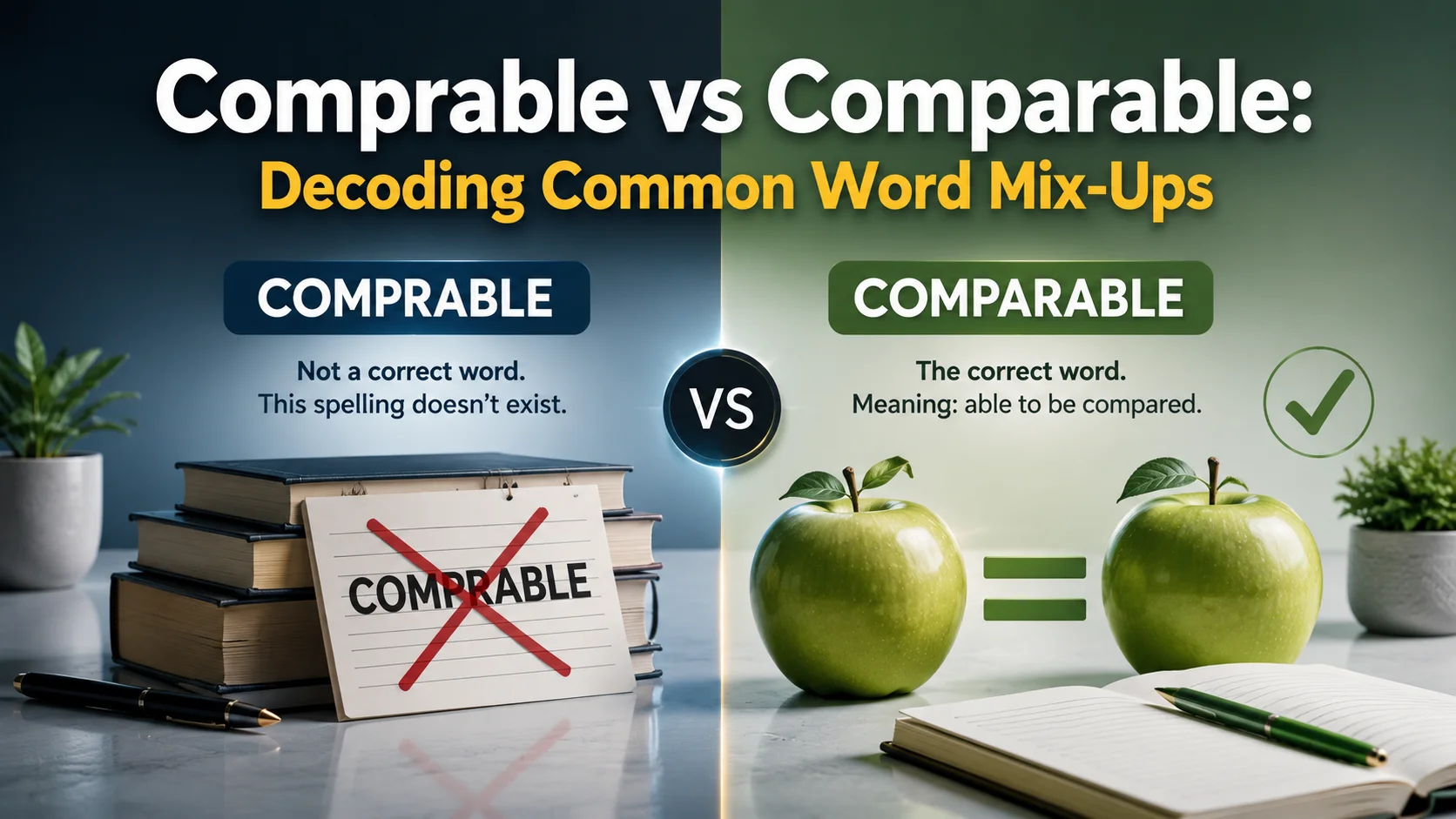
Comprable vs Comparable: Decoding Common Word Mix-Ups shows how writers must stay careful in writing to avoid confusion between comparable and comprable in context.
In my professional editing experience, many people often confuse the correct word, even in sentences used for legal, financial, and scientific comparisons, where comparable clearly means similar in nature, quality, or quantity, while comprable is a misspelling and usually incorrect, showing clear misuse of language. It is important to always check spelling, proofread, and write clearly so you use word correctly, avoid overusing terms, and ensure understandable communication, helping you avoid mistakes and improve clarity when describing ideas properly, especially when regional differences and variations may allow confusion, but careful attention keeps accuracy strong and communication precise.
Comprable vs Comparable: Why This Confusion Happens in the First Place
At first glance, “comprable” looks legitimate. It sounds close to “comparable,” and your brain tries to fill in the missing piece.
So why does this mistake happen so often?
Here’s what usually causes it:
- Fast typing leads to dropped letters
- Your brain hears the word and simplifies the spelling
- Auto-correct sometimes fails silently
- People assume “-able” words follow the same pattern
Think of it like texting “definately” instead of “definitely.” You know the correct version, but muscle memory gets in the way.
The good news? Once you understand the structure of the real word, the mistake becomes easy to avoid.
Read more: Stopped or Stoped: The Hidden Truth Behind the Spelling
Is “Comprable” Even a Real Word?
Let’s clear this up immediately.
“Comprable” is not a valid English word.
You won’t find it in standard dictionaries like:
- Oxford English Dictionary
- Merriam-Webster Dictionary
- Cambridge Dictionary
It doesn’t have a definition, history, or grammatical role. It exists purely as a misspelling of “comparable.”
Why it still shows up online
Even though it’s incorrect, it appears in:
- Social media posts
- Blogs written quickly
- Student essays
- Auto-generated or unedited content
So if you’ve seen it before, you’re not imagining things—it’s just a spelling error that spreads easily.
What Does “Comparable” Actually Mean in Comprable vs Comparable?
Now let’s focus on the correct word.
Comparable means something that can be compared because it shares similarities with another thing.
But here’s the important nuance:
👉 Comparable does NOT mean identical
👉 It means “similar enough to compare fairly”
Simple definition
If two things are comparable, they:
- Share measurable traits
- Can be evaluated side by side
- Show meaningful similarities or differences
Example in real life
- Two smartphones with similar camera quality
- Two job offers with similar salaries
- Two laptops with similar performance
You’re not saying they are the same. You’re saying they are close enough to compare meaningfully.
Why “Comprable vs Comparable” Gets Confused So Often
Language plays tricks on us.
The brain prefers shortcuts, especially when words sound similar. “Com-par-a-ble” has four syllables, while “comprable” feels faster and smoother to say.
Here’s what fuels the confusion:
Pronunciation blur
When spoken quickly, the middle “a” sound becomes soft. You barely notice it.
Typing habits
Fast typing leads to skipped letters. Especially the “a” in the middle.
Visual similarity
The difference is just one missing vowel. That’s easy to miss at a glance.
Pattern assumption
People assume English words follow predictable patterns. They don’t always.
How to Use “Comparable” Correctly in a Sentence
Using the word correctly is simple once you see the structure.
Most of the time, you’ll use it like this:
- A is comparable to B
- A and B are comparable
- These two things are comparable in quality
Common sentence patterns
- This phone is comparable to the latest iPhone.
- His performance is comparable to top industry leaders.
- The two products are comparable in price and durability.
A quick tip
If you can replace it with “similar enough to compare,” then you’re using it correctly.
Real Examples of “Comparable” in Action
Let’s make this practical. Here are real-world styled examples across different situations.
Technology
- This budget laptop is comparable to mid-range models from 2023.
Education
- The online course is comparable to traditional classroom training.
Business
- Their service quality is comparable to premium competitors.
Everyday life
- This local café is comparable to popular coffee chains in taste.
Each example shows comparison—not equality.
Why “Comprable” Should Never Appear in Formal Writing
Here’s the blunt truth: using “comprable” in professional writing damages credibility.
It signals:
- Lack of attention to detail
- Weak proofreading
- Poor familiarity with standard English spelling
Even if your ideas are strong, one wrong word can make readers question everything.
Imagine this scenario
You write a business proposal and say:
“Our pricing is comprable to competitors.”
A hiring manager or client immediately notices the error. It distracts from your message.
That tiny mistake can cost trust.
Common Mistakes in Comprable vs Comparable Usage
Let’s look at the most frequent errors people make.
Mistake: Using “comprable” instead of “comparable”
- Incorrect: The two offers are comprable
- Correct: The two offers are comparable
Mistake: Thinking “comparable” means identical
Comparable means similar enough to compare, not the same.
Mistake: Confusing “comparable” and “complementary”
This one causes real confusion:
| Word | Meaning |
| Comparable | Similar enough to compare |
| Complementary | Works well together or enhances something |
Mistake: Overusing “comparable”
Sometimes “similar” or “equivalent” works better.
Comparing Comparable with Similar and Equivalent
Let’s simplify this further so you can use the right word every time.
| Word | Meaning | Best Use Case | Example |
| Comparable | Can be fairly compared | Products, performance, value | These two phones are comparable |
| Similar | Has resemblance | Appearance, traits | The designs look similar |
| Equivalent | Exactly equal in value | Math, formal logic | 10 dollars is equivalent to 1000 rupees |
Think of it like a scale:
- Similar = looks alike
- Comparable = can be compared
- Equivalent = equal
Where Context Changes Meaning in Real Use
Context decides everything in language.
Business context
Companies use “comparable” when analyzing:
- Revenue
- Product performance
- Market share
Example:
- This year’s sales are comparable to last year’s figures.
Academic context
Researchers use it to compare:
- Studies
- Data sets
- Experimental results
Example:
- The findings are comparable with earlier research.
Everyday context
You might say:
- This phone is comparable to that one in battery life.
Memory Tricks to Never Confuse Comprable vs Comparable Again
Let’s make this stick in your mind.
Trick 1: Break the word
com-par-a-ble
Say it slowly. You’ll never miss the “a” again.
Trick 2: Link it to “compare”
Comparable = compare + able
If you can compare it, it’s comparable.
Trick 3: Spot the fake
If you see “comprable,” assume it’s wrong immediately.
Practice Exercises: Test Yourself
Let’s lock in your understanding.
Exercise 1: Choose the correct word
- The two cars are ______ in performance.
- This version is ______ to the original.
- Their salaries are not ______.
Answers:
- comparable
- comparable
- comparable
Exercise 2: Fix the mistake
Rewrite correctly:
- The products are comprable in price.
- Her results are comprable to his.
Correct versions:
- The products are comparable in price.
- Her results are comparable to his.
Exercise 3: Identify meaning
What does “comparable” mean?
A) Exactly equal
B) Similar enough to compare
C) Completely different
Correct answer: B
Conclusion
Understanding comparable vs comprable is not just a spelling issue, it directly affects how clear and professional your writing looks. The correct word comparable helps express similarity in nature, quality, or quantity, especially in legal, financial, scientific, and everyday comparisons like features and price differences. On the other hand, comprable is simply a misspelling that leads to misuse of language and weak communication.
In real writing practice, the key is to slow down, always check spelling, and proofread carefully. This ensures you use word correctly, avoid common mistakes, and maintain understandable communication. With consistent attention, you can write more clearly, confidently, and professionally.
FAQs
1. What is the correct word: comparable or comprable?
The correct word is comparable. It means things that are similar in nature, quality, or quantity.
2. Is “comprable” a real English word?
No, comprable is a misspelling and is considered usually incorrect in standard English writing.
3. Where is the word “comparable” commonly used?
It is used in legal, financial, scientific, and product comparisons, especially when discussing features and price differences.
4. Why do people confuse comparable and comprable?
People confuse them due to similar spelling, lack of attention, and weak proofreading habits in writing.
5. How can I avoid making this mistake?
You should always check spelling, proofread, write clearly, and ensure you use word correctly in sentences for better professional communication.