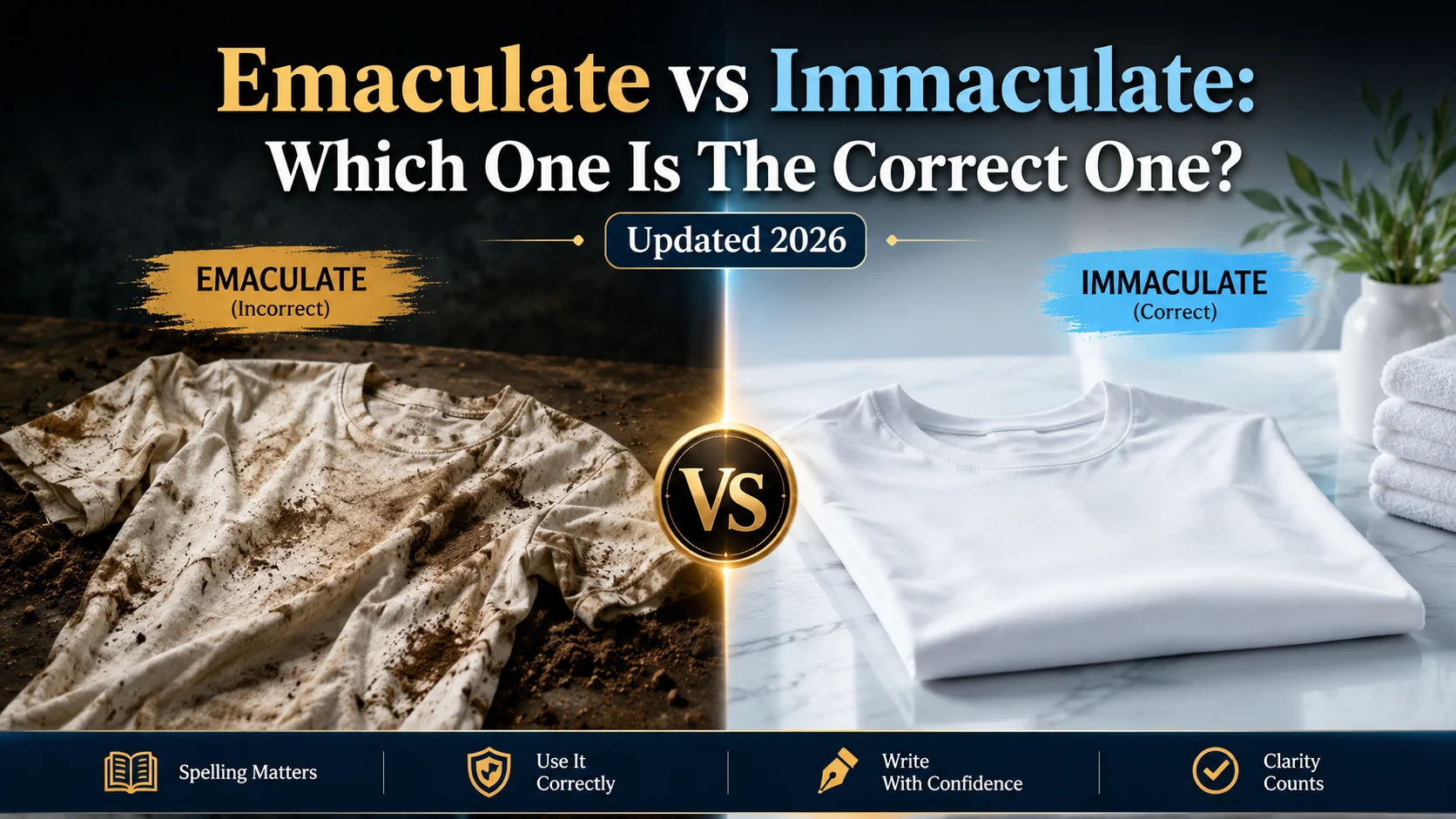
In the English language, many people often get confused because words can sound similar yet have completely different meanings in real use, especially in the case of Emaculate and Immaculate. This creates common confusion where users mistakenly type or say Emaculate while they actually mean Immaculate. This happens because both are two words that seem related, and understanding meanings is essential for clear communication, writing accuracy, and avoiding embarrassing grammar mistakes. Although both may appear in some texts, Emaculate is not officially recognized as an English word, while Immaculate, on the other hand, is widely used and conveys idea of being perfectly clean, flawless, and pure.
This article tries to explore difference, define both terms, and show how to use correctly in sentences and different contexts, because many are confused vs usage in real writing, and knowing the meaning differences helps improve writing accuracy and avoid spelling mistakes in everyday communication.
Emaculate vs Immaculate: Quick Answer You Actually Need
Let’s cut through the confusion.
- Immaculate → Correct word in English
- Emaculate → Incorrect spelling (not recognized in dictionaries)
That’s it. No hidden meaning. No alternate usage. Just one right word and one common mistake.
However, the confusion still exists because the mistake looks believable. English has plenty of weird spellings, so people assume “emaculate” might be one of them.
It isn’t.
Read more: Unenroll vs Disenroll: Meaning And Differences
What Does Immaculate Mean in Simple Words?
The word immaculate describes something that is extremely clean, flawless, or perfect in appearance or condition.
Think of it like this:
If something looks like it has never been touched by dirt, chaos, or error, it’s immaculate.
Simple meanings of immaculate:
- Spotlessly clean
- Perfectly neat
- Without flaws or marks
- Extremely well-maintained
Real-life meaning examples:
- A freshly cleaned white room with no dust → immaculate
- A football player’s perfect performance → immaculate
- A neatly pressed suit before a wedding → immaculate
The word carries a sense of admiration. When you call something immaculate, you’re saying it looks exceptionally good.
Does Emaculate Mean Anything?
No. “Emaculate” has no official meaning in English.
It does not appear in:
- Oxford English Dictionary
- Merriam-Webster Dictionary
- Cambridge Dictionary
So why do people still write it?
Here’s what actually happens:
Why “emaculate” shows up online:
- Fast typing leads to missing the letter “i”
- People mishear “im-mac-u-late”
- Autocorrect sometimes fails to correct it
- Social media repetition spreads the typo
In short, it’s a digital accident, not a real word.
The Origin of “Immaculate” (Why the Word Exists)
To understand why “immaculate” is the correct form, we need to go back in time.
The word comes from Latin:
immaculatus = “without stain” or “unclean”
Break it down:
- im- = not
- macula = stain or spot
So originally, it literally meant “without stain.”
Historical usage:
- Used in religious texts to describe purity
- Later adopted in formal English writing
- Expanded into modern usage for anything perfect or spotless
Today, we use it in both literal and figurative ways:
- Clean room → literal meaning
- Perfect performance → figurative meaning
Why People Confuse Emaculate and Immaculate
This confusion is more common than you think.
Here’s why your brain tricks you:
Sound similarity
When spoken quickly, “im-ma-cu-late” can blur into “emaculate.”
Typing speed
Most people type fast on phones. The letter “i” often gets skipped.
Pattern assumption
English has irregular spellings, so people assume both forms might exist.
Social media effect
Once a typo spreads online, it starts to look “normal.”
Memory Trick: Never Confuse Emaculate and Immaculate Again
Let’s make this stick in your memory.
Simple trick:
“Immaculate starts with ‘I’ for ‘Intensely clean.’”
Now picture this:
- A giant white mansion
- No dust anywhere
- Everything shines like glass
That image = immaculate
Another trick:
Say it slowly:
“im-MAC-u-late”
Stress the “I” at the beginning. Your brain will lock it in.
How to Use Immaculate in Real Sentences
The word “immaculate” is flexible. You can use it in casual speech or formal writing.
Everyday usage:
- “Your room looks immaculate after cleaning.”
- “That outfit is immaculate, I love it.”
Professional usage:
- “The report was immaculate and well-structured.”
- “Her presentation was immaculate under pressure.”
Emotional tone:
It often shows admiration, respect, or surprise.
Sentence Examples That Show Correct Usage
Let’s make this real so you can see how native speakers use it.
Correct examples of “immaculate”:
- The hotel room was immaculate, with no dust anywhere.
- His timing in the race was immaculate, breaking a record.
- She walked into the meeting with an immaculate presentation.
Incorrect examples using “emaculate”:
- ❌ The kitchen was emaculate after cleaning.
- ❌ He wore an emaculate suit to the wedding.
These feel wrong because “emaculate” breaks standard spelling rules.
Common Mistakes People Keep Making
Even smart writers make this mistake sometimes.
Here’s what usually goes wrong:
Typing too fast
Speed kills accuracy. One missing letter changes everything.
Relying only on autocorrect
Autocorrect doesn’t always fix rare typos.
Learning by sound instead of spelling
English pronunciation can be misleading.
Assuming both forms exist
This is the biggest trap.
How to Avoid the Mistake Permanently
You don’t need complex grammar rules. Just build habits.
Practical tips:
- Slow down when typing unfamiliar words
- Always double-check before publishing
- Read your sentence out loud
- Use browser spellcheck tools
- Train yourself to recognize “immaculate” visually
Simple rule to remember:
If it looks like “emaculate,” it’s wrong.
Synonyms and Antonyms of Immaculate
Expanding your vocabulary helps you avoid overusing the same word.
Synonyms (similar meaning):
- Spotless
- Pristine
- Flawless
- Pure
- Perfect
- Neat
Antonyms (opposite meaning):
- Dirty
- Messy
- Unclean
- Tarnished
- Flawed
Example:
Instead of saying:
- “The room is immaculate”
You can also say:
- “The room is spotless”
- “The room looks pristine”
Context Matters: When to Use Immaculate
Not every situation needs this word.
Best contexts:
- Cleanliness (rooms, clothes, surfaces)
- Performance (sports, work, art)
- Appearance (outfits, design, presentation)
Overuse warning:
If everything is “immaculate,” the word loses power.
For example:
- A slightly clean desk is not immaculate
- A decent report is not immaculate
Use it when something truly stands out.
“Emaculate” in Modern Internet Culture
Here’s something interesting.
Even though “emaculate” is incorrect, it still appears online.
Where you’ll see it:
- Social media comments
- Meme captions
- Fast texting conversations
- Autocorrect mistakes
It’s basically a digital typo that refuses to disappear.
But remember:
Just because you see it online doesn’t make it correct.
Comparison Table: Emaculate vs Immaculate
| Feature | Emaculate | Immaculate |
| Correct spelling | ❌ No | ✅ Yes |
| Dictionary status | ❌ Not recognized | ✅ Official word |
| Meaning | None | Clean, flawless |
| Usage | Typo only | Proper English |
| Professional use | Never | Always appropriate |
Practice Exercises (Learn by Doing)
Let’s test your understanding.
Fill in the blank:
- The house looked ______ after cleaning.
- His grammar was ______ in the essay.
- The hotel room was ______ and neat.
Correct answers:
- immaculate
- immaculate
- immaculate
Spot the mistake:
Which is correct?
- A) emaculate performance
- B) immaculate performance
Answer: B
Rewrite correctly:
- “The emaculate design impressed everyone.”
Correct version:
- “The immaculate design impressed everyone.”
Real-World Insight: Why This Confusion Matters
This isn’t just about spelling. It affects clarity and credibility.
In professional writing:
- Misspelling “immaculate” can make writing look careless
- Recruiters and readers may notice errors quickly
- Search engines may flag incorrect spelling as low quality
According to writing studies, spelling errors can reduce perceived credibility by up to 30% in professional documents.
So yes, one letter matters more than you think.
Final Takeaway: Emaculate vs Immaculate
Let’s keep it simple.
- Immaculate = correct, real, widely used
- Emaculate = typo, mistake, incorrect spelling
If you remember one thing, remember this:
Conclusion
The confusion between Emaculate and Immaculate happens mainly because both words sound alike, but only Immaculate is the correct and widely accepted English word. It means something that is perfectly clean, flawless, or pure. On the other hand, Emaculate is not officially recognized in English and is often used by mistake or confusion with similar-sounding words. Understanding this difference helps improve your writing accuracy, avoids spelling mistakes, and supports better clear communication in everyday use. When you choose the correct word, your writing becomes more confident, precise, and professional.
FAQs
1. What is the correct word: Emaculate or Immaculate?
The correct word is Immaculate. It is the standard English word used in writing and speaking.
2. What does Immaculate mean?
Immaculate means something that is perfectly clean, flawless, pure, or without mistakes.
3. Is Emaculate a real English word?
No, Emaculate is not officially recognized in the English language. It is usually a spelling mistake.
4. Why do people confuse Emaculate and Immaculate?
People confuse them because they sound similar, but only Immaculate has a real meaning and correct usage.
5. How can I remember the correct spelling?
Remember that Immaculate = I am clean (idea of perfect purity), which can help you avoid the common spelling mistake.