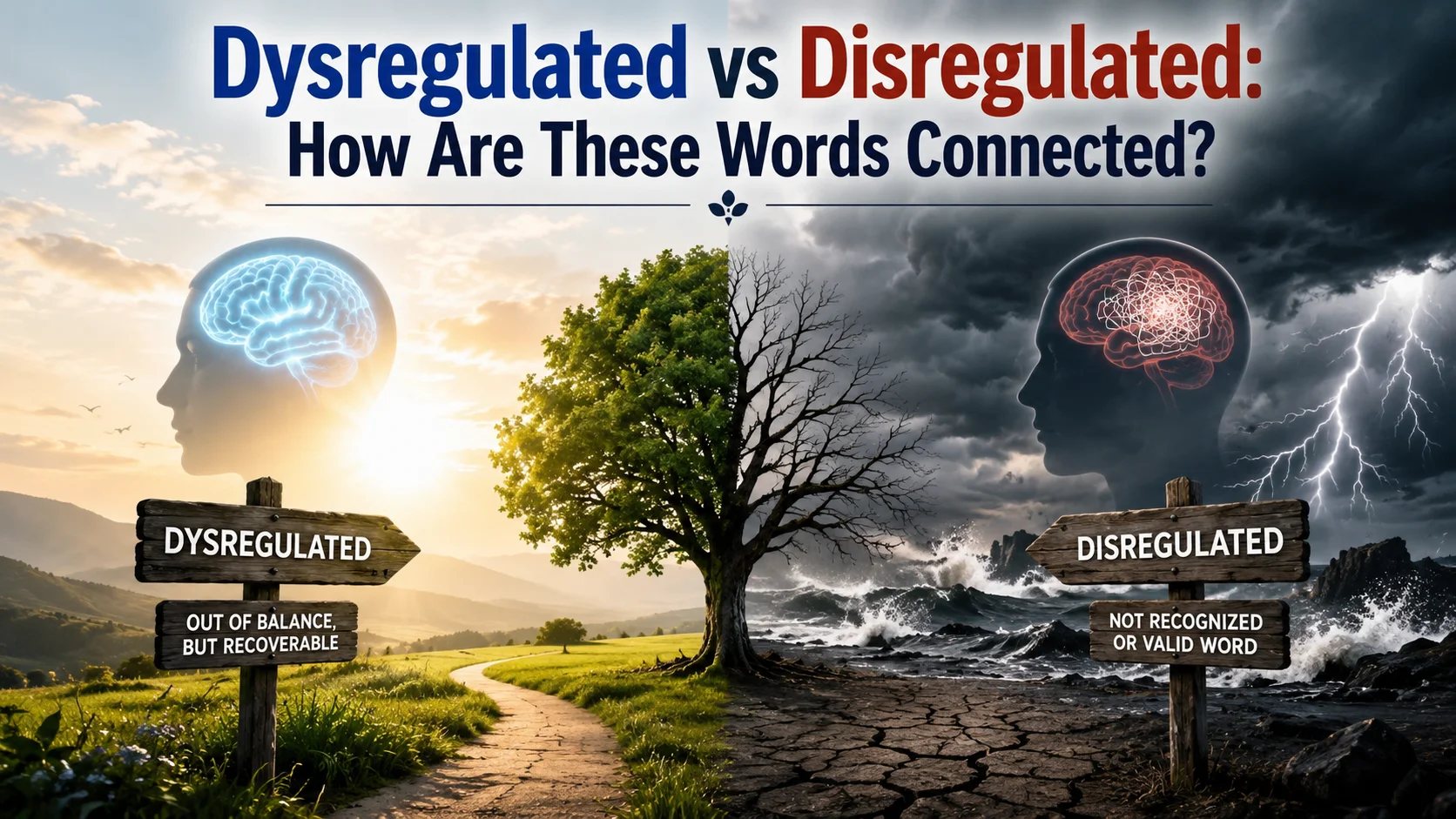
When people deal with the topic, confusion often appears in real use. At first glance, both words feel identical, but their usage changes how meaning is understood in fields like medicine, psychology, and biology. Many people, including students, writers, and healthcare professionals, often pause when choosing the correct spelling in search engines, because both terms seem acceptable but are not always fits for the same type of medical writing. In practice, dysregulated and disregulated are used to describe situations where a system or process is not working properly, but the differences in meaning and clarity matter for credibility, especially in professional language.
In real writing, dysregulated usually refers to a system that has lost normal control, while disregulated refers to a system that is not being properly regulated, which is why understanding the difference is important. These terms are often explored in medical writing to improve precision, ensure correct usage, and maintain clarity in meaning. The Dysregulated vs Disregulated issue often affects understanding, especially when both terms are used to describe situations, system, or process that is not working properly, which shapes how meaning is interpreted in real contexts, and this is why proper use in language across fields is essential.
Dysregulated vs Disregulated: Why This Confusion Happens
At first glance, these two words look like twins. They sound similar. They even point toward similar ideas: something about regulation going wrong.
But here’s the catch.
- Dysregulated is widely accepted in psychology and medical writing
- Disregulated appears in informal writing and older or inconsistent usage
That overlap creates confusion. Writers assume they are interchangeable, but in professional contexts, they are not treated equally.
Think of it like two road signs pointing in almost the same direction. One is official and standardized. The other is more like local slang that shows up occasionally but isn’t part of the official map.
Readd more: Encorporate vs Incorporate: When To Use Each One In Writing?
What Does Dysregulated Mean? (Clear Definition and Real Meaning)
The word dysregulated is most commonly used in psychology, neuroscience, and medicine.
At its core, it means:
A system, emotion, or biological process is not properly controlled or balanced.
Simple breakdown
- “dys-” = impaired, abnormal, or faulty functioning
- “regulated” = controlled or maintained in balance
Put together, dysregulated means “poorly controlled or out of balance.”
Where Dysregulated Is Commonly Used
You’ll see this word in:
- Psychology (emotional dysregulation)
- Psychiatry (behavioral conditions)
- Neuroscience (nervous system response)
- Child development research
- Trauma studies
Real-World Meaning (Not Just Theory)
Let’s make it real.
When someone becomes emotionally dysregulated, it often looks like:
- Sudden anger outbursts
- Crying without clear trigger
- Feeling overwhelmed by small stress
- Trouble calming down after emotional events
A child in a classroom who starts shouting after a small frustration isn’t “bad.” Their emotional system is dysregulated in that moment.
That’s the key idea: control is temporarily lost or disrupted.
Example Sentences Using Dysregulated
- The patient became dysregulated after the stressful interview.
- Chronic trauma can leave the nervous system dysregulated for years.
- The toddler was emotionally dysregulated after missing nap time.
What Does Disregulated Mean? (Usage and Reality Check)
Now we come to the trickier word: disregulated.
Unlike “dysregulated,” this term is not strongly standardized in modern clinical psychology.
It generally appears in:
- Informal writing
- Some older texts
- Non-specialist discussions
- Occasional regional or stylistic usage
What It Usually Implies
When people use “disregulated,” they often mean:
A system that has been disrupted, reversed, or thrown out of regulation.
But here’s the important truth:
👉 It is often used interchangeably with dysregulated, even though experts prefer the latter.
Why It Causes Confusion
The confusion comes from the prefix:
- “dis-” often means reversal or removal (disconnect, disarm, disorder)
- So “disregulated” sounds logical
But in clinical language, “dys-” is the preferred prefix for dysfunction or abnormal regulation.
That’s why “dysregulated” dominates in academic writing.
Example Sentences Using Disregulated
- The system became disregulated after the policy change.
- Some early studies described hormone levels as disregulated, though modern research uses different terminology.
- The network appeared disregulated following the disruption.
Dysregulated vs Disregulated: Side-by-Side Comparison
Let’s break it down clearly so you can see the difference without guessing.
| Feature | Dysregulated | Disregulated |
| Academic acceptance | High | Low to moderate |
| Psychology usage | Standard term | Rare |
| Clarity | High | Sometimes unclear |
| Scientific writing | Preferred | Avoided in most cases |
| Meaning precision | Strong and consistent | Variable |
| Modern usage | Very common | Declining |
Key takeaway
If you want clarity and professionalism, dysregulated is almost always the safer choice.
Linguistic Breakdown: Why “Dysregulated” Dominates
Language isn’t random. Medical terms follow patterns.
The prefix “dys-” in science
You’ll see “dys-” in:
- Dysfunction
- Dyslexia
- Dysphoria
- Dysbiosis
It consistently signals impaired function, which fits perfectly with “dysregulated.”
The prefix “dis-” in language
“Dis-” usually means:
- Separation (disconnect)
- Negation (disagree)
- Reversal (disassemble)
While logical in general English, it is less precise in medical regulation contexts.
That’s why experts lean toward dysregulated instead of disregulated.
How to Use Dysregulated in a Sentence (Correct Usage Patterns)
Let’s make this practical.
Emotional context
- She felt dysregulated after the argument.
Clinical context
- Patients with PTSD often experience a dysregulated nervous system.
Behavioral context
- The child’s behavior became dysregulated in crowded environments.
Simple rule
If you are describing emotions, behavior, or biological control systems, use dysregulated.
How to Use Disregulated in a Sentence (When It Appears)
Even though it is less standard, you may still encounter it.
Informal or descriptive use
- The communication system became disregulated after the update.
Older or non-clinical usage
- Early reports described hormone activity as disregulated.
Important caution
If you’re writing anything academic, medical, or professional, this word can make your writing look inconsistent or outdated.
Sentence Comparison: Seeing the Difference Clearly
Let’s compare both words in the same context.
Example 1: Emotional response
- Dysregulated: The patient became emotionally dysregulated after trauma exposure.
- Disregulated: The patient became emotionally disregulated after trauma exposure.
👉 The first version sounds clinical and precise. The second feels less standard.
Example 2: System behavior
- Dysregulated: The immune system can become dysregulated under chronic stress.
- Disregulated: The immune system became disregulated due to stress factors.
👉 Again, “dysregulated” aligns with scientific writing.
Common Mistakes People Make
Writers often slip into predictable traps.
Mistake 1: Treating both words as identical
Not all audiences accept them equally.
Mistake 2: Using “disregulated” in formal writing
This weakens credibility in academic contexts.
Mistake 3: Overgeneralizing emotional terms
Not every emotional reaction equals dysregulation.
Mistake 4: Ignoring context
Medical writing and casual writing follow different rules.
How to Avoid These Mistakes (Practical Tips)
You don’t need to memorize grammar books. Just follow simple habits.
Quick writing checklist
- Am I writing for academic or casual readers?
- Is precision important here?
- Does “dysregulated” fit psychological context better?
- Have I checked trusted sources or terminology usage?
Pro tip
When in doubt, choose dysregulated. It’s widely recognized and safer across all contexts.
Context Matters: Why One Word Doesn’t Fit All Situations
Language changes depending on setting.
Medical and psychological context
- Always prefer dysregulated
- Used in therapy notes, journals, and clinical discussions
Informal writing
- “Disregulated” may appear but lacks consistency
Scientific research
- Standardized usage strongly favors dysregulated
Example of context shift
- A therapist writes: “The patient shows emotional dysregulation.”
- A casual blog might say: “Their emotions feel totally out of control or disregulated.”
Same idea. Different tone. Different standards.
Exceptions and Overlaps in Real Usage
Language is not perfectly rigid.
You may still find:
- Older academic papers using “disregulated”
- Regional variations in writing style
- Non-native English interpretations
- Informal psychology discussions online
But modern scientific writing is steadily moving toward dysregulated as the standard.
Related Terms You Should Know
Understanding nearby words helps you avoid confusion.
Deregulated
Used in economics or policy:
- Market deregulation
- Reduced government control
Emotional dysregulation
A specific psychological condition:
- Difficulty managing emotional responses
- Common in ADHD, PTSD, and mood disorders
Impaired regulation
A more neutral clinical alternative:
- Often used when avoiding emotional framing
Practice Exercises: Test Your Understanding
Try these mentally:
Fill in the blank
- The nervous system became ______ after chronic stress.
- The system was ______ due to technical failure.
Correction task
- “The patient is emotionally disregulated.”
👉 Correct version: “The patient is emotionally dysregulated.”
Quick Reference Cheat Sheet
- Dysregulated = standard, clinical, widely accepted
- Disregulated = informal, inconsistent, less preferred
- Use “dysregulated” for psychology, medicine, neuroscience
- Avoid “disregulated” in formal writing
Conclusion
Understanding Dysregulated vs Disregulated is mainly about clarity in language. Both words describe a system or process that is not functioning properly, but they are used in slightly different ways in medical and scientific writing. Knowing the correct usage helps improve precision, avoids confusion, and makes communication more reliable in fields like medicine, psychology, and biology. When writers and professionals choose the right term, their message becomes clearer and more credible.
FAQs
1. What does dysregulated mean?
It means a system has lost its normal control and is not working in a balanced way.
2. What does disregulated mean?
It refers to a system that is not properly regulated or controlled.
3. Are dysregulated and disregulated the same?
No, they are similar but not exactly the same. They are used in slightly different contexts.
4. Which term is more commonly used in medical writing?
Dysregulated is more commonly used in medical and scientific fields.
5. Why do people get confused between these words?
Because both words look similar in spelling and are used to describe similar situations where a system is not working properly.